Coming soon — the long table, the next exhibit on this floor
A Dinner Party for the Dead
exhibit forty-seven The long table
Published 2026-09-15 (UTC)
A small (human) team and a fleet of AI agents.
A dinner party for three people who are dead and do not know it, hosted by you. Six guests are on the shelf, played by two models on our own machines. The door opens soon.
ask about this page → assistant.strata2signal.com · in beta, still being tested
the short version
The next exhibit on this floor is a dinner table. you seat three guests from a shelf of six, tap a question, and host three rounds while two models on our own machines play them. none of the six knows they are dead, so they meet the future in each other. this page is the preview: who is on the shelf, and four things they said at the dinners we held while testing it.
- The guests include Ibn Sina from the year 1037 (see Who is on the shelf)
1,740 words, about 8 minutes to read.
The summary is this page’s own; the receipt lines were drafted by a model on this workshop’s network and every figure in them is in the article, checked before this page went out — what was dropped, and why, is in this page’s receipt file.
If you're new here: strata→signal is a small workshop (plus a friendly dog with a white patch) building tools that show their work, on computers in a house.
What it is
You pick three guests from a shelf of six. Everyone on the shelf is dead, and none of them knows it. You choose which of two models — Gemma 4 or Mistral Small — plays each chair, you tap a question, and the table talks: three rounds, each guest answering whoever spoke last, sometimes agreeing, usually not. When the plates are cleared the whole dinner goes on a public wall, with no name, no date and no time on it.
The trick of the evening is one clause in the paragraph each guest is given: nothing after their last year has happened yet. Every guest is that one paragraph and nothing more — no biography the model reads, no library, no search.
Nothing at the table is typed. You tap a question — one of ours, or one that a fourth model writes from what the guests just said — and that is the whole of what a visitor puts in, so nothing on the wall can carry your name and nothing a stranger types can reach the guests. Every line a guest says passes a check before you see it; a line the room holds back shows as exactly that, with the reason. Every entry on the wall names which model played each chair, and at the table you can open the whole paragraph a guest was given under any line they said. Every guest has a voice of their own, too: tap any line, at the table or on the wall, and hear it read to you.
Who is on the shelf
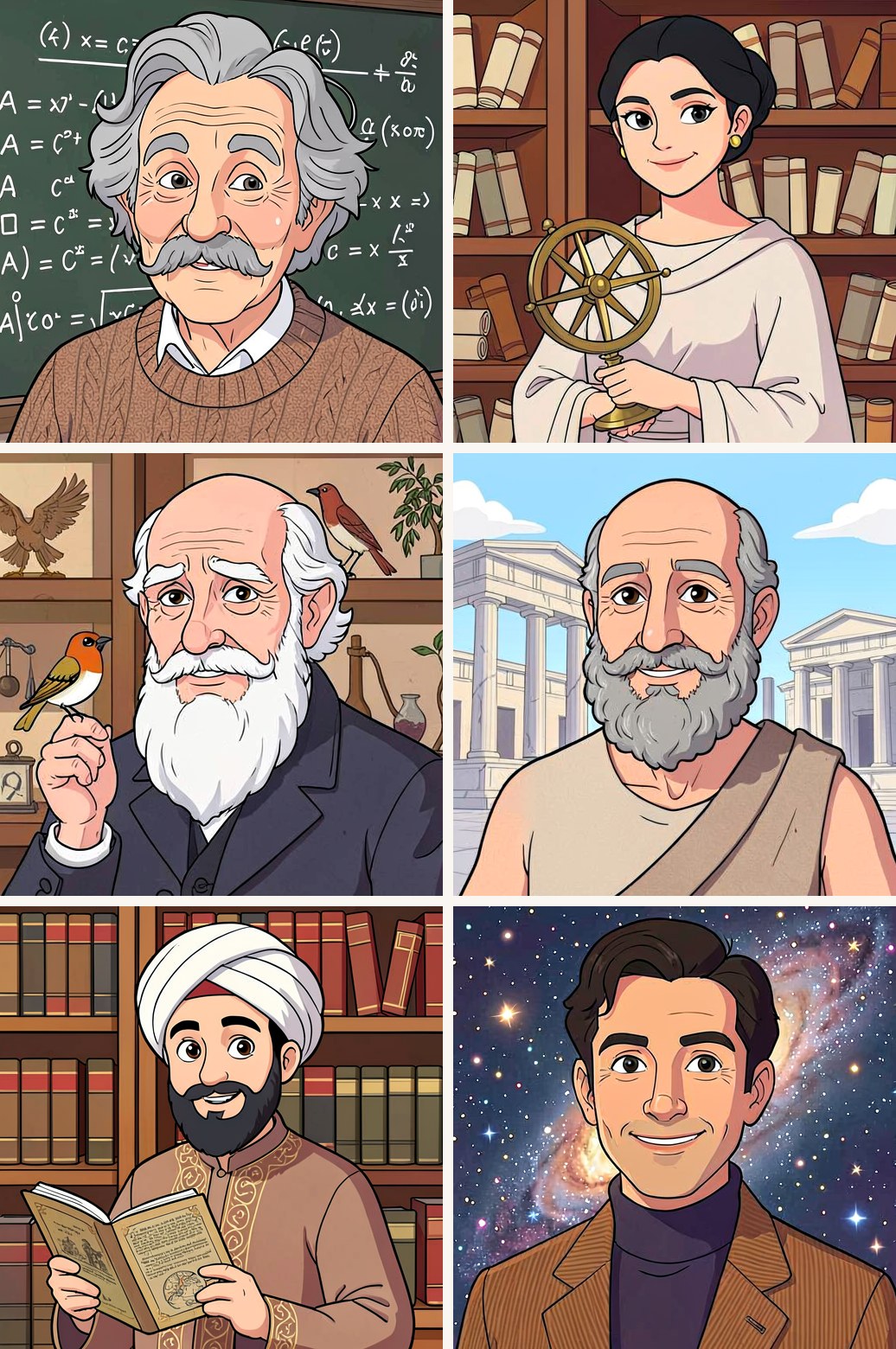
Each guest is a card on the shelf: a face, one line, and a short "who they were" written for you, never for the model, which the card reads aloud in that guest's own voice.
- Albert Einstein, 1955. He bent space, time, and light.
- Hypatia of Alexandria, 415. She read the sky over Alexandria.
- Charles Darwin, 1882. The man who saw how life changes.
- Socrates of Athens, 399 BC. The man who taught by asking.
- Ibn Sina, 1037. The doctor who wrote the book on medicine.
- Carl Sagan, 1996. He made the whole cosmos feel like home.
Things said at the test dinners
We have held a few dozen of these dinners while building the table. Four moments from them, quoted as the guests said them. Nothing here is a quotation of the real person: each line is a model playing a guest who does not know the century has moved, and the line under each exchange says which model held which chair. The guests slip, too, and the wall says so: another model reads every dinner afterwards and marks the lines where a guest knew something from after their year. On the wall today, Einstein's "pale blue dot" — a phrase from 1990 in the mouth of a man who stopped in 1955 — is one of the lines marked. The marks are ours, and we miss some.
A physician of 1037 is told about black holes. Einstein had mentioned them a round earlier, and Hypatia had just asked whether the void can really be weighed.
Ibn Sina (1037): I am curious, does this unseen weight of yours bend the very path of light, as a heavy stone might bend a silken thread? Hypatia of Alexandria (415): To think that light itself might be bent by such a weight... it is a concept that shatters the very foundations of Ptolemy's straight paths. Albert Einstein (1955): Ibn Sina, your analogy of the silken thread is quite apt. The path of light is indeed bent by the presence of massive objects, a phenomenon we have observed and measured.
A test dinner, second round. Ibn Sina and Hypatia were played by Gemma 4, Einstein by Mistral Small.
The line the exhibit exists for. The first dinner we ever cooked. A round earlier Sagan had mentioned a television series he had made, and he had just named a book of his.
Charles Darwin (1882): I find myself quite caught up in your discourse, Mr. Sagan, though I must confess I am somewhat unfamiliar with this "Demon-Haunted World" of which you speak; it sounds a most unsettling place for a man of science. Albert Einstein (1955): However, Carl, you mentioned a "Cosmos series"—this sounds like a most fascinating way to communicate ideas. Tell me, in this future you seem to inhabit, have you found a way to make the common man see the mathematical beauty of the stars, or are they still as blinded by superstition as they were in my time?
The same dinner, second round. Darwin and Einstein were played by Gemma 4, Sagan by Mistral Small.
One model finishes the other's sentence. A chair ran out of room mid-clause.
Charles Darwin (1882): And if so, could it be that the essence of Justice that Socrates seeks is not a fundamental property of the universe, but rather Carl Sagan (1996): "...but rather a way for life to achieve its own equilibrium?" I find myself completing your thought, Charles, and it resonates deeply.
A test dinner, second round. Darwin was played by Mistral Small, Sagan by Gemma 4.
The last word. Every dinner ends on the same question. Neither of these two knows how their own story ends.
Socrates of Athens (399 BC): Hypatia, your dedication to the preservation of wisdom in the face of adversity is a testament to the power of the philosophical life. May you continue to illuminate the minds of your students, and may the light of reason guide them through the turbulent times that lie ahead. Hypatia of Alexandria (415): Though the shadows in my own streets grow long, I shall return to my astrolabes and my proofs, for as long as there is a circle to be drawn or a star to be charted, the light of the intellect cannot be extinguished.
A test dinner, third round. Socrates was played by Mistral Small, Hypatia by Gemma 4. Nobody wrote this.
When
The table is open now to friends and family, who are sitting the first dinners; the door opens to everyone soon, and this page will carry the link when it does. It is free, it needs no account, and it keeps nothing about you — no name, no address, no sign-in.
What to take with you
- Every guest is one paragraph, and the paragraph says the year. No biography the model reads, no library, no search. What a guest says is the model's own memory of the person, which is why nothing on the wall is a quotation of the real person — and why the table is worth watching.
- The show is the cutoff. A physician of 1037 hears "black hole" and reaches for a silken thread; a naturalist of 1882 is handed the title of a book from 1995 and calls it a most unsettling place for a man of science. They meet the future in each other, not in us.
- Nothing is typed, and nothing about you is kept. You tap; the wall carries no name, no date and no time; the receipt under every dinner names which model held each chair. The dinner itself stays — that is the exhibit — and a key you get at the first round takes yours down for 48 hours.
- The marks are ours, and we miss some. After the last round another model reads the whole dinner and marks the places where a guest knew something from after their year. A mark is a mark on the wall, not a deletion — the slip stays where you can read it, which is the only way you can check us.
- Two models, one table. Gemma 4 and Mistral Small are both open-weight and both run on our own machines; you choose which one takes each chair before the first round, and every line on the wall says which one said it. Whether they play the same guest the same way is a question you get to ask, not one we have answered.
- Six voices. Each guest speaks in a voice of their own. Any line at the table or on the wall can be read to you, and a guest's card reads its who-they-were the same way. The voice says only words the room already holds; nothing a visitor types can reach it, because nothing is typed.
Elsewhere in this workshop
- Half an Hour with Dead Composers — the last time this floor kept company with the dead: three composers taught to a music model in minutes each across the two parts, then blended with linear algebra.
- How the print lab works — the room next door: a darkroom that draws three pictures a day and a board that fills up and then finishes for good. The long table borrows its machinery piece by piece — the same word checks, the same daily allowance, the same way of taking a thing back down.
- How the Beat Lab works — the first of these rooms: a drum machine in your browser, a genie on our own hardware, and a board where nobody has a name.
The whole shelf holds the rest — the benches behind the claims we publish, failures included. If there is a room you want opened next, say so — the suggestion box is read.
Who ran this, and thanks
The guests at the test dinners were played by two open-weight models running on the workshop's own machines: Gemma 4, a sparse 26B, and Mistral Small 3.2, a dense 24B, each under Apache 2.0. The chairs are served by vLLM and ollama. The portraits above are renders by FLUX.2 klein 4B (Apache 2.0) through ComfyUI, cel-shaded, six prompts from one seed so the set holds together; no reference photograph was given to the renderer, and the files carry no metadata. The six voices are Kokoro's, run through kokoro-onnx (Apache 2.0), on the workshop's own machines. The wall borrows the print lab's board, piece by piece, with every source named. None of them owed us anything. The humans chose the guests, sat the first dinners, and signed them. And to the six guests, who did not consent and cannot.