The notes — the door to the four exhibits anyone can walk into, and how the door itself got built
Introducing the playground
exhibit fifty-four The notes
Published 2026-09-20 (UTC)
A small (human) team and a fleet of AI agents.
One door, and behind it a rotating, curated set of four exhibits you can walk into. Today: a dinner party for the dead, a drum machine with a genie, a darkroom on a public wall, and a walking tour with footnotes. All free, no account needed, every answer made on machines this workshop runs. Below the introduction: how the door itself got built, in four rounds in one day, with the receipts.
ask about this page → assistant.strata2signal.com · in beta, still being tested
the short version
The playground is one door onto four exhibits a stranger can use today: the long table, the Beat Lab, the print lab and amble. it loads nothing from anyone else's servers, keeps nothing about who opened it, and says of each exhibit only how it works, never whether its own door is open this minute. the second half of this page is the door's own story: four tiles that sat as a row of three and an orphan, one of them a screenshot of text, re-hung as a grid of four pictures in four rounds on 2026-09-19, every layout rendered and measured before it shipped.
- The long table has been open to anyone since 2026-09-19 (see What is behind the door)
- The door as it stood on the morning of 2026-09-19 (see How the door was built: four rounds in one day)
- The smallest thing a reader can tap is 225 px (see How the door was built: four rounds in one day)
2,877 words, about 13 minutes to read.
The summary is this page’s own; the receipt lines were drafted by a model on this workshop’s network and every figure in them is in the article, checked before this page went out — what was dropped, and why, is in this page’s receipt file.
strata→signal is a small workshop that runs its own machines and writes up what it measures. Every number on this page is a measurement of a rendered page, a file on disk, or the arithmetic of a grid.
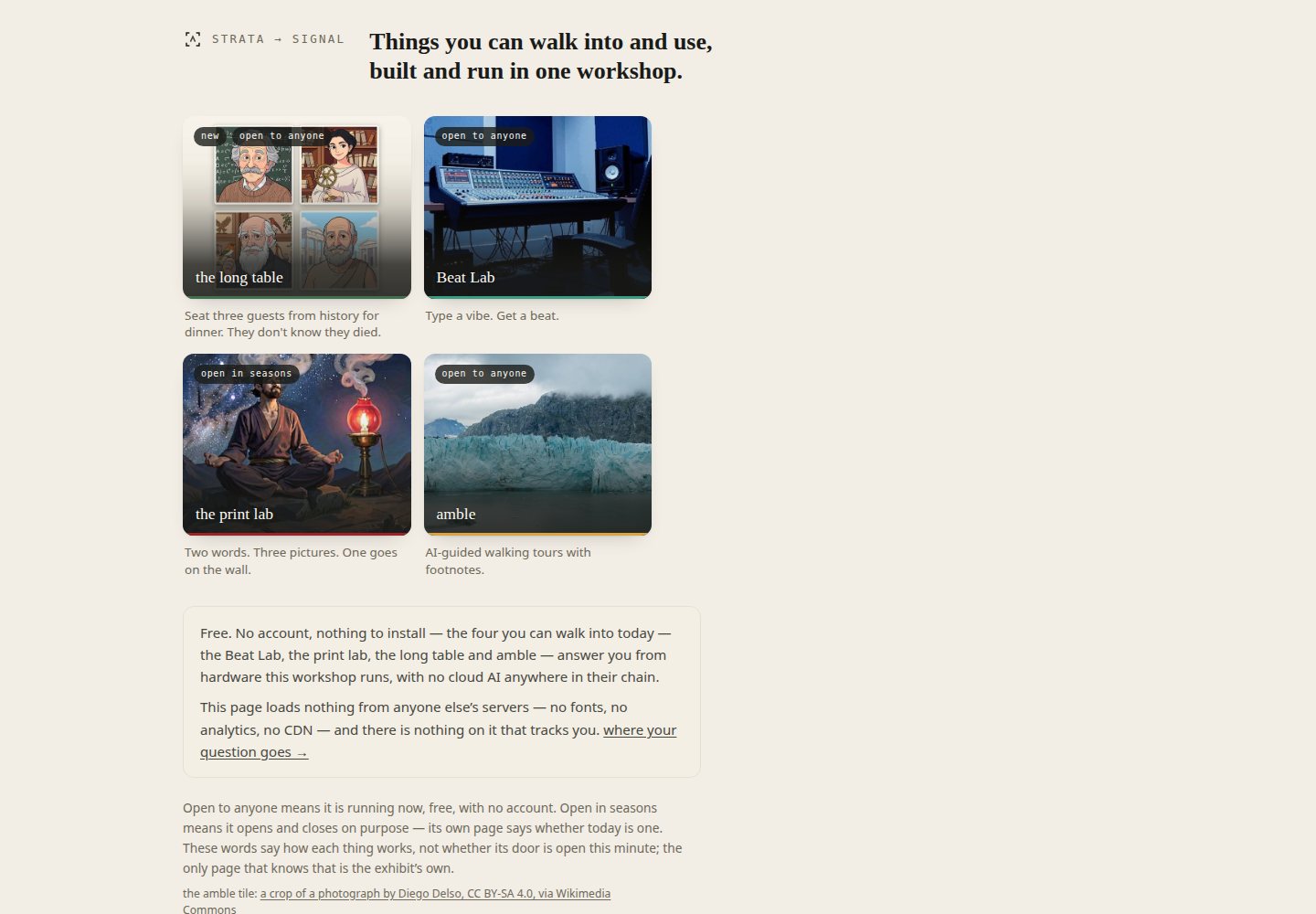
The door on 2026-09-20 (UTC), rendered at 1,440 px wide.
What is behind the door
Four things, each on its own address. The door's own promise, word for word: "Free. No account, nothing to install — the four you can walk into today — the Beat Lab, the print lab, the long table and amble — answer you from hardware this workshop runs, with no cloud AI anywhere in their chain." And of itself: "This page loads nothing from anyone else’s servers — no fonts, no analytics, no CDN — and there is nothing on it that tracks you."
- The long table. "Seat three guests from history for dinner. They don't know they died." Three chairs, six guests on the shelf, a question from you, and two open-weight models on the workshop's own machines play the guests for three rounds. Every dinner goes on a public wall with its receipts. Open to anyone since 2026-09-19; the invitation is on this shelf.
- The Beat Lab. "Type a vibe. Get a beat." A drum machine in your browser, and a genie that turns a few words, or a photo, into a groove on the workshop's own models. Put it on the board; nobody's name goes with it. Open to anyone. How it works.
- The print lab. "Two words. Three pictures. One goes on the wall." A public art board with a darkroom attached: give it a word or two, an image model on the workshop's own machines draws three pictures, and you keep one, or none. Open in seasons: it opens and closes on purpose, and its own page says whether today is one. How it works.
- amble. "AI-guided walking tours with footnotes." It walks you through real places and only says what each walk's own notes say; ask past them and it tells you it hasn't got that. Open to anyone. Take a walk.
Two words on the door carry weight and are defined on the page: "Open to anyone means it is running now, free, with no account. Open in seasons means it opens and closes on purpose — its own page says whether today is one. These words say how each thing works, not whether its door is open this minute; the only page that knows that is the exhibit’s own."
What the door is, and is not
"A door, not an exhibit: it links to what the workshop built and keeps nothing about who opened it." That sentence is the door's footer and its whole design brief. There is no script on the page, no font fetched, no analytics, no CDN. Whether the reader's device prefers light or dark, the page is light.
The playground is a curated set of four exhibits, and the set rotates: what is behind the door is a choice, made four at a time in the door's registry, and it will change as the workshop builds. Four, because four sit evenly on a page and a stranger takes them in at a glance. RuleSage, the rules desk for over a thousand games, is another open exhibit anyone can use today; it is just not on the playground right now, which is what a rotating set means. RealKeep, the game in build, is not open yet. Both are on the workshop's front page.
What follows is the second half: how the door itself came to look the way it does. A reader who came for the exhibits has everything above.
How the door was built: four rounds in one day
The door opened on 2026-09-15 with four tiles. By the morning of 2026-09-19 it looked like this.
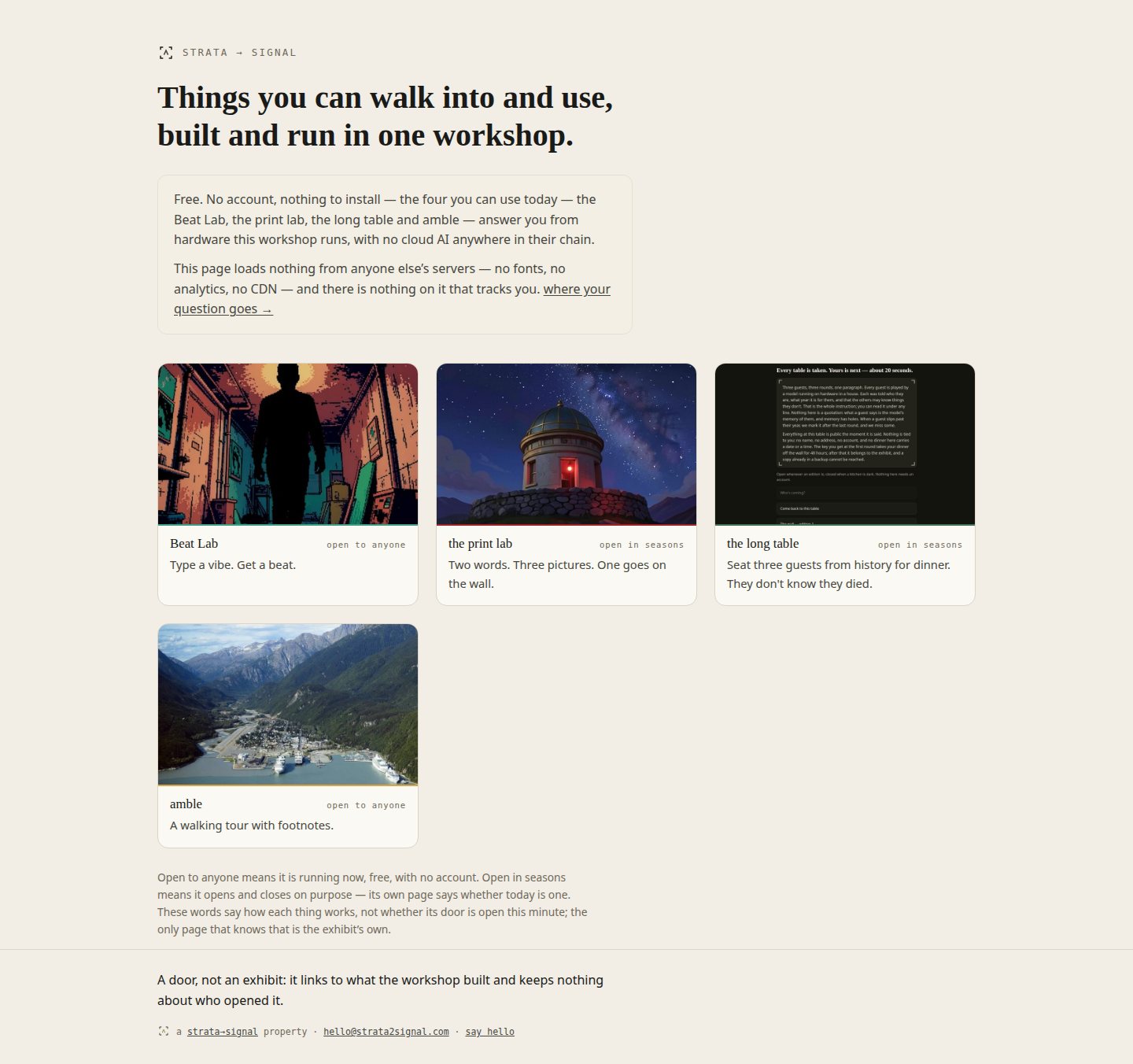
The door as it stood on the morning of 2026-09-19 (UTC), rendered at 1,440 px wide: three tiles and an orphan, and the third tile a screenshot of text. Two words and one line on it changed later that day; the rounds below say which.
What was wrong, in three parts
An operator, on a desktop, 2026-09-19: "the tiles don't look super great … there's 3 in one row, and one in the next row, and overall it just isn't vibing with me … I was hoping for a bit more of a modern look."
Three separate complaints, and they came apart cleanly, in the order they were made:
- The orphan was arithmetic. The door's grid went one column, then two at 720 px, then three at 1080 px. The door shows four tiles. Three into four is a row of three and a row of one at every ordinary desktop width.
- One tile was not a picture. The long table's still was that exhibit's own page proof, a screenshot of text. The tool that keeps the door's stills had said so since the tile went up: the only still in the set that is text where the other three are pictures, and at 400 px that text is a grey texture. It was the third tile, so it sat in the middle of the desktop row.
- "More modern" is taste. A build lane does not get to rule on taste, so it was built as a choice rather than an answer.
Round one: two looks, and a verdict
The first pass fixed the grid: one column below 720 px, two from 720, four from 1400, and never three. Four tiles then land as 1+1+1+1, 2+2 or 4, and no row holds an orphan at any width. It offered two looks on the same markup, selected by one word on the page's body tag: hairline cards with the name and invitation beneath, or the still filling a rounded frame with the name set on the picture.
The verdict: "they both look super similar to the current version, but the image is better for the long table … maybe if the tiles showed up in a 4x4 grid."
Both looks had kept the shape, a row of picture tiles with words under them, and changed the chrome, which is not a new look. The one thing round one got right was the picture. The long table's tile became a composed still rather than a painted one: three of the exhibit's own guest portraits as matted cards on the house's warm paper, no lettering in frame, no image model run, built twice to the same bytes. By evening it had given way to a grid of four.
Round two: three grids, as pictures first
"A 4x4 grid" was taken literally and built as pictures to choose between before any of it touched the shipping page. One generator, three variants: every picture cell is an exhibit out of the door's registry and every text cell is a title and a sentence lifted from a page that already publishes them. What a variant changes is how many columns and rows a cell spans, and those spans are emitted from a table in the generator so the picture and the arithmetic cannot disagree. The generator's check lays every variant out the way a grid's row flow actually lays it out and refuses a variant that leaves a hole.
| Variant | What it is | Cells at four columns |
|---|---|---|
| G1 the full grid | Four exhibits, each spanning 2×2, nothing else in the frame | 4 × (2×2) = 16, none empty |
| G2 the mixed grid | The long table 2×2; three exhibits as 2×1 bands; six small text cells | 4 + 6 + 6 = 16, none empty |
| G3 the masonry | Pictures at two sizes and text cells filling what is left, two of them widened so nothing is dropped | 4 + 2 + 2 + 4 + 4 = 16, none empty |
G3's "nothing dropped" is where the arithmetic bit: eight picture cells and six text links is 14, not a multiple of four, so two holes. Widening two links to 2×1 closes them at no cost, so that is how it was built.
All three were rendered at 400, 900 and 1440 px through the door's own proof harness, and read before the pick. Two costs changed what shipping meant. At 900 px every variant was a 3,223 px page: "two columns, each exhibit 2×2" makes every exhibit an 860×691 picture that nearly fills a laptop screen, and a reader scrolls four of them. And the promise strip was in none of the frames; cutting the hero to one row had left no room for the sentence about cloud AI, which the door is not allowed to drop.
Round three: the pick, and what it had to pay
An operator, the same day: "roll the new 4 grid layout." G1 shipped: four pictures, two to a row, the name on the picture and the posture word as a small pill. The costs above were paid before the deploy rather than after. The promise strip came back, directly under the grid, every word as the branch carried it when the grid landed. The laptop band became two-up, each exhibit one cell instead of a 2×2 span, so the 3,223 px page never shipped; below 720 px the stills go back to their native 16:10 and crop nothing. The fan was re-fit inside the squarer crop by moving two numbers in its recipe together. And the invitations stayed on the page, hidden inside each tile's own link, so a reader who cannot see the picture still hears "Seat three guests from history for dinner. They don't know they died."
No word was changed by the look pass. An independent reviewer diffed every text node and every alt of the shipping page against the same page rendered from the commit before the grid landed: the only difference is position. Two words on the door did change that morning, in a separate commit that has nothing to do with the layout: the long table's posture went from "open in seasons" to "open to anyone" when its own door opened to everyone, and the promise strip's lede changed one verb, "use" to "walk into". Because the before picture above was shot minutes earlier, both of them show in it.
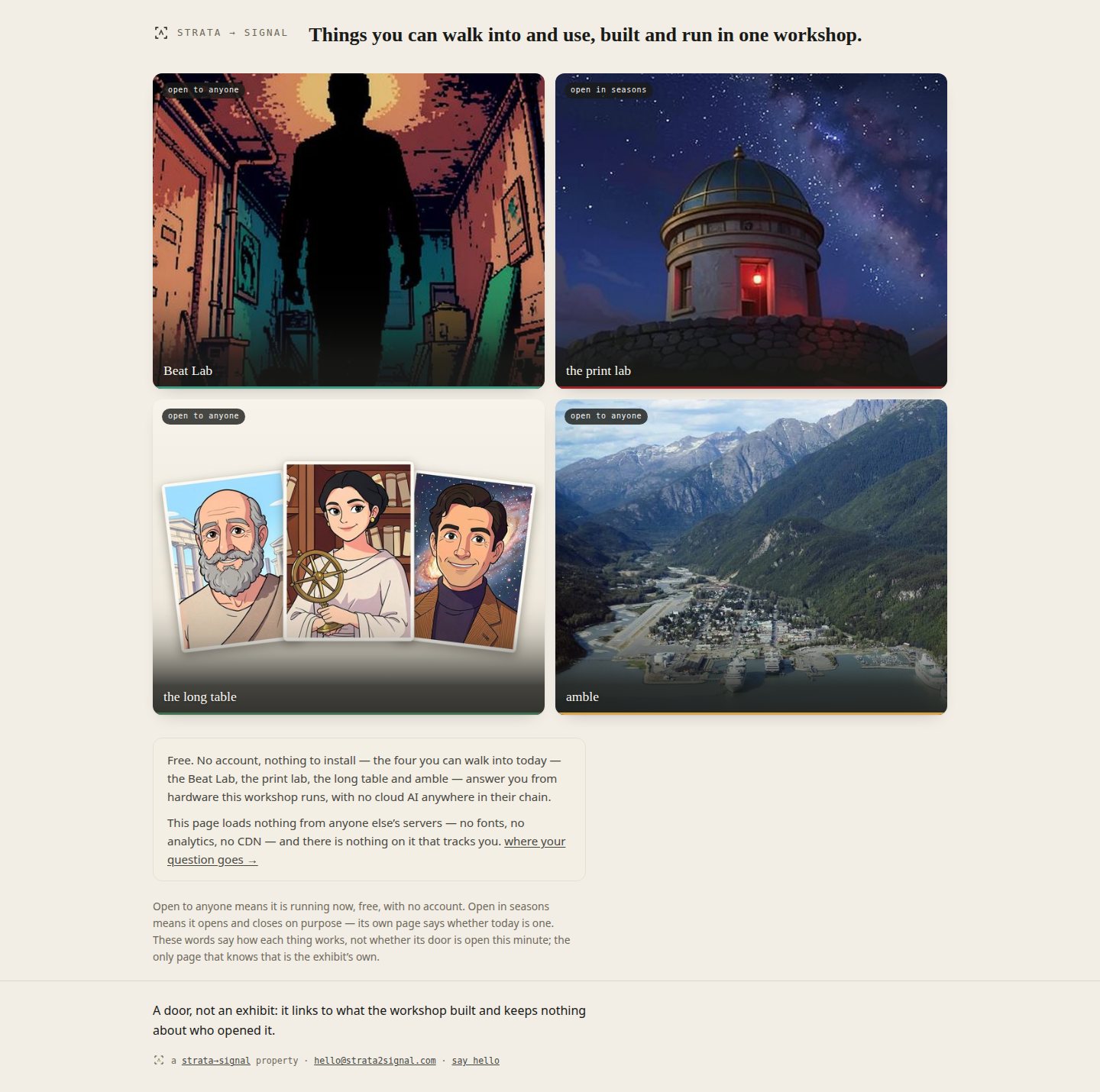
The door after round three, rendered at 1,440 px wide, 2026-09-19 (UTC), about 21:00.
Round four, the same evening: the pictures, the order, and half the size
The door as it ships came out of a fourth round that same evening, 2026-09-19 (UTC), about 22:10 to 23:59, the round the picture at the top of this page shows. An operator asked for six things that evening, and the licence added a seventh. The long table moved to the first tile. Every tile was halved, from 513×413 to 249.5×199.6 px at the desktop width, and on one more ask, a line return after the first two panels, the four were set two by two on the left of the page rather than in one row across. All four pictures changed, and each one's ledger row says where the bytes came from, when they were fetched and under what right:
- The long table is a grid of four of the exhibit's own portraits, Einstein, Hypatia, Darwin and Socrates, as matted square cards on the house paper, composed by the same tool as the fan it replaces, deterministic, built twice to the same bytes.
- The Beat Lab is one of its own sleeves, the cover its painter drew for a beat on the public board, in the sleeve round of 2026-09-07. That beat's own record names the painter; the lab's own explainer says what the painter is, in its own words: a small open-weight image model, FLUX.2 klein 4B, Apache 2.0, on one of the workshop's machines.
- The print lab is a picture from its own public wall, slot 53, painted on 2026-09-14 from a visitor's two words, "steam" and "meditation", in the world the lab calls quiet observatory: a seated figure and one red lamp under the Milky Way. The licence is read off the lab's own record for that slot, and the lab keeps no name with a picture.
- amble is a crop of a photograph of a glacier face, the same photograph its own tour uses for a hero, by Diego Delso, CC BY-SA 4.0, via Wikimedia Commons. The crop was taken off the Commons panorama rather than the exhibit's own smaller cut, so nothing was scaled up.
Two of those four are served by their exhibits at 512 pixels square and the door's stills are 768×480, so the sleeve and the wall picture are scaled up by half, and their rows say so.
- The credit line. The glacier is somebody else's photograph under a licence that asks for visible attribution, so the door grew a credit line under its legend, generated from the registry the same way the tiles are: the one item here a licence wrote.
- The invitations came out of hiding, on an operator's own call: each tile's sentence now reads under its picture in the muted ink, and the tap target is picture and invitation together.
- amble's line on the door became the one its product page publishes, "AI-guided walking tours with footnotes"; the before picture above still shows the old one.
- The share card a link to the door shows in a chat or a feed is now composed from the same four stills, and a check refuses a card whose inputs drift from the committed pictures.
- The "new" pill on the long table is driven by the date its door opened in the registry; it retires itself two weeks on, at the first deploy after.
Two review agents read the round, and their fixes landed before the deploy. The one worth telling: the invitation had been clamped to three lines, and at 200 per cent browser text the clamp cut words in half. It was removed. The invitations now run as long as they run, and the row's bottom edge stays straight because the links are one height, not because the invitations are.
Measured: the morning, the pick, and what ships
All three columns measured 2026-09-19 (UTC) with the same harness in the same browser: "before" is the door as it stood that morning, "round three" is the pick as it landed that evening, "as it ships" is the door at the top of this page. Heights are the whole page; a tile is one exhibit's picture.
| Width | Before (morning) | Round three | As it ships |
|---|---|---|---|
| 400 px | 1 column · 360×224 tile · page 2,253 px | 1 column · 360×225 tile · page 1,774 px | 1 column · 360×225 tile · page 1,947 px |
| 900 px | 2 columns · 419×261 tile · page 1,454 px | 2 columns · 423×338 tile · page 1,307 px | 2 columns · 423×338 tile · page 1,425 px |
| 1440 px | 3 columns + an orphan · 332×206 tile · page 1,352 px | 2 to a row · 513×413 tile · page 1,430 px | 2 by 2 on the left · 249.5×199.6 tile · page 1,171 px |
The smallest thing a reader can tap is a whole tile with its invitation, 225 px high at the narrowest width, against a 44 px floor the harness refuses to go under. At every width the light and dark renders were pixel-identical.
What this page does not know
- Whether the new door is better. Nobody has measured a visitor against either layout. The before and after are photographed at three widths; the judgment was one operator's, on one desktop.
- How the page reads on a phone in a hand. The harness renders 400 px; it does not hold the device.
- Where the promise should sit. It is under the four pictures at every width, which puts the no-cloud sentence past the first screen on a phone. Moving it above the grid is one block; whether it should move is a call this page has not made.
- What the two rejected grids would have done for the workshop's writing. G2 and G3 put six of the workshop's own pages on the door, the long table's invitation, two how-it-works pages, the walk-through of where a question goes, the hardware roster and the family map; the door that ships puts none. They remain one generator run away.
Who ran this, and thanks
The exhibits behind the door each have their own thanks on their own pages. For the door: the proofs were shot by the workshop's own harness driving a headless Chromium, the only browser that touched the page. The composed stills were laid out with Pillow. The four portraits in the long table's tile are that exhibit's own, rendered earlier by FLUX.2 klein 4B (Apache 2.0) through ComfyUI, cel-shaded, and carry no metadata; the Beat Lab's sleeve and the print lab's wall picture were painted by the same model on the workshop's machines, under the same licence, read off each exhibit's own record. The glacier is a photograph by Diego Delso, CC BY-SA 4.0, via Wikimedia Commons, cropped and credited on the door. The layouts were built and audited by AI agents working in lanes; the humans chose the grid, read the proofs, picked the pictures, and signed it.