The bench — what this page prices, on which day, and what it does not
The 3080 Rig, Priced
exhibit eighty-one The bench
Published 2026-10-14 (UTC)
A small (human) team and a fleet of AI agents.
A desktop built around a used RTX 3080 with 10 GB of video memory costs $1,357.61 in seven parts plus the card, or $1,500.57 with the parts a reader would actually want, before tax and before a screen, from one US retailer and one used-card marketplace read in the same three minutes on 8 October 2026. The 32 GB of RAM beside the card cost more than the card that day, as it has on each of the four days this workshop has priced the build since 10 September.
ask about this page → assistant.strata2signal.com · in beta, still being tested
hardware on this page: RTX 3090 (24 GB) · RTX 3080 (10 GB) · the mini PC → research.strata2signal.com/hardware/ · the roster is in beta, still being tested
the short version
A desktop around a used 10 GB RTX 3080 costs about $1,360 in parts, or about $1,500 built the way you would want it, before tax, on 8 October 2026. The card is $358 on one marketplace's printed twelve-month average of completed sales, and $376.67 in the latest month of that window; the 32 GB of RAM beside it is $439.99. The speeds on this page come from an older desktop the card was benched in, not the one priced here: on the two models that fit inside the card it writes seventy to eighty-five tokens a second, twelve to fifteen times that desktop's processor alone; on the four that don't, just under two to five and a half times. The full bench has not had its own page yet; this one is the bill.
4,317 words, about 20 minutes to read.
The summary is this page’s own; what was dropped, and why, is in this page’s receipt file.
If you're new here: strata→signal is a small workshop that builds things on its own machines and writes up what it measures. This page belongs to a series that prices the computers those measurements ran on: a mini PC with no graphics card at the bottom, two used 10 GB cards in an older desktop in the middle, and one and two 24 GB RTX 3090s at the top. This one prices a new desktop around one used 10 GB card, the build a reader would buy rather than the one this workshop already owned, and by price it sits just under the middle rung.
A few words this page leans on
- Token — the chunk a model reads and writes in, a little under a word. Twelve tokens a second is about a line of text every second; around ten reads as fluent, four to six as comfortable.
- VRAM — the memory on the graphics card itself, 10 GB on this one. A model that fits inside it runs on the card alone; one that does not is split.
- RAM — the computer's own memory, on sticks in the motherboard, 32 GB in both builds here. It is where the rest of a split model lives, and it is what most people mean by "memory" when they shop.
- GiB — a binary gigabyte, 1,073,741,824 bytes, which is how a computer reports its own memory; 16 GiB is about 17.2 GB.
- Split — what the software does when a model does not fit in VRAM: it keeps part of the model on the card and the rest in RAM, and every word waits on the slower half.
- Mixture of experts — a model that wakes only a few billion of its parameters for each word. On a processor alone, a 26-billion-parameter mixture writes faster than a 12-billion model that uses everything; on a card that holds the 12-billion model whole and only part of the mixture, the 12-billion one wins.
- Completed sale — a price somebody actually paid, as against an asking price somebody hoped for. This page prices the used card on one marketplace's printed average of completed sales, says how that average is built, and names the marketplace.
- Marketplace seller — a third party selling on the retailer's storefront under its own return policy, as against the retailer selling the part itself. Both kinds appear on the tables below and each line says which it is; "the maker's own store" is a marketplace seller run by the part's maker.
- Modular — a power supply whose cables detach, so the case holds only the ones in use.
- Pre-tax — every price here is before sales tax.
What this page prices, and what it does not
It prices a new desktop around one used graphics card: processor, cooler, motherboard, 32 GB of RAM, a 1 TB drive, a case and a power supply, from one US retailer's storefront, read between 02:25 and 02:27 UTC on 8 October 2026, at the price shown to a buyer with no account, with any instant discount the listing itself applies already taken off. It prices the card three ways: used, on one marketplace's printed twelve-month average of completed sales, with that window's latest month beside it; refurbished; and new. It does not price a monitor, keyboard, mouse or operating system, or shipping beyond the one line that charged it. It does not price the older desktop this workshop actually ran the bench in; the middle page of this series does, and the speeds here came from that machine.
The computer, as this workshop ran it
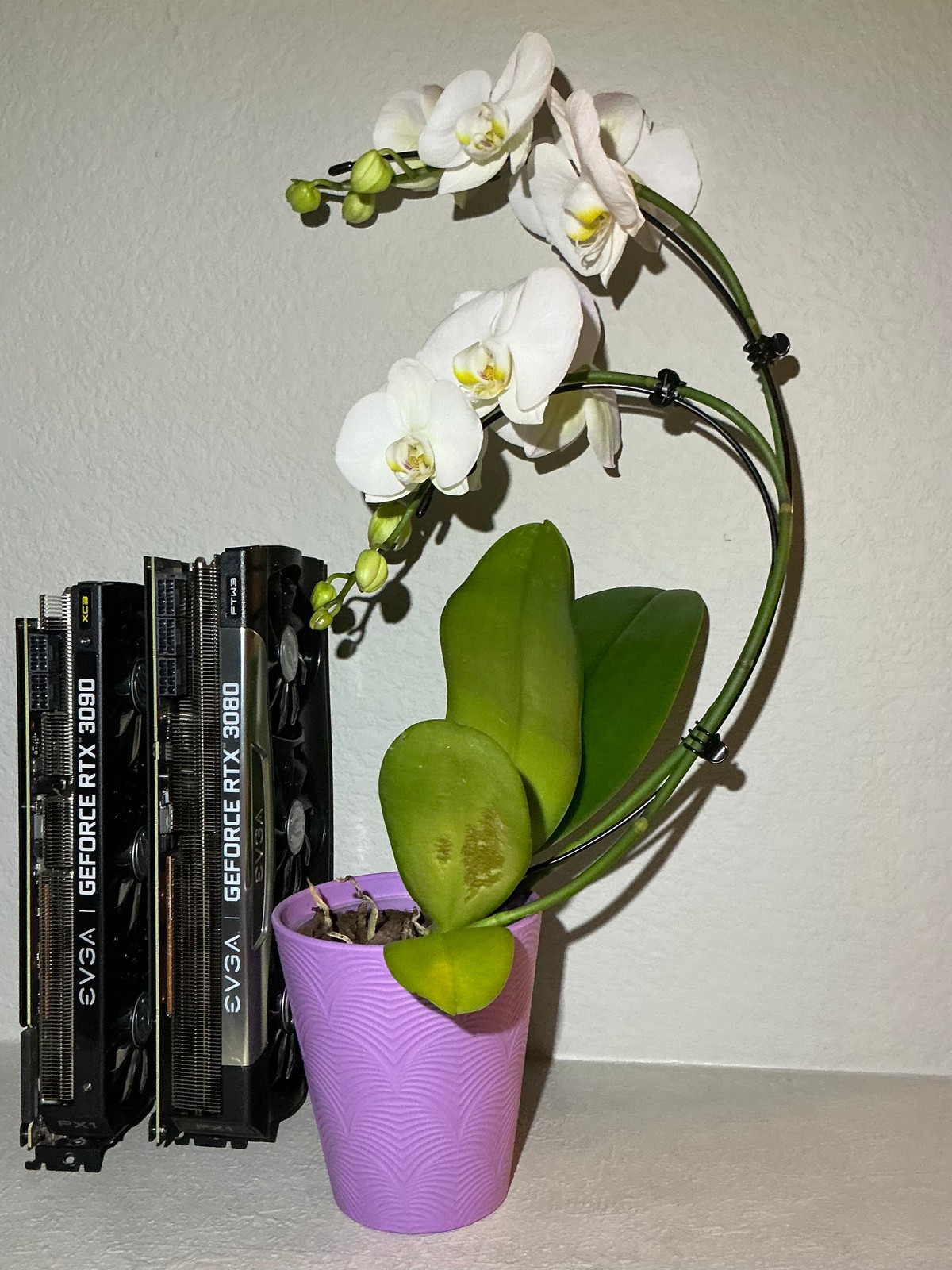
The card that ran the bench on 10 September 2026 was an EVGA RTX 3080 FTW3 with 10 GB, new and sealed until that morning, at its board maker's factory power limit of 380 W. It is a long card, 300 mm, and nearly three slots thick; both cases below clear it, the first by 40 mm and the second by 105 mm. The desktop it sat in is not the build priced here: it is the older desktop this series prices part by part, with 48 GB of DDR4-3200 as built, 45 GiB as the system reports it, and its processor is the one the speeds table below calls "the bench desktop's processor". The used prices below are for a 10 GB RTX 3080 of any make, because the marketplace averages the model, not this board. New, an FTW3 Ultra of the same family was $795.00 on the same storefront on 8 October, from a marketplace seller, against $358 used; the page prints both so the reader can see the gap.
Build A: the cheapest honest desktop
Seven parts. Each line other than the memory is the part this workshop chose on its first reading, 10 September, re-priced on every read since at the listing a visitor with no account is shown; the memory line is the cheapest in-stock kit of its class on each day, the class being 32 GB as two 16 GB DDR5-5600 desktop sticks. "Honest" means nothing under-sized for the card and nothing a buyer would have to replace first.
The power supply is sized by a rule this page prints rather than a number it asserts: the card's rating, plus 105 W for the processor, a cushion above the 88 W package limit AMD publishes for its 65 W chips, plus about 100 W for the board, drives and fans. On the reference card's 320 W rating that is about 525 W continuous, and this generation of card is known for millisecond surges well above its rating, which is what trips an undersized supply, so the rule takes forty per cent on top: about 735 W, and 750 W is the chip maker's own system recommendation. One caveat the page owes the reader: the card this workshop benched is not a reference design, and at its 380 W factory limit the same rule asks for about 820 W, which build B's 850 W supply covers. The $358 row below is for a 10 GB RTX 3080 of any make, most of them partner boards whose factory limit a used listing often does not state; a reader who cannot tell should take build B's supply, and build A with it is $1,024.61 in parts and $1,382.61 with the card.
| Line | The listing | Sold by | Price |
|---|---|---|---|
| Processor | Newegg, "AMD Ryzen 5 7600", six cores, socket AM5, listed as "Processor Only", a loose chip without the cooler the boxed one ships with; shown at $20.73 off $176.40 | A marketplace seller | $155.67 |
| Cooler | Newegg, "Vetroo V5", five heat pipes, 120 mm fan, shown at $5.00 off $24.99 | A marketplace seller | $19.99 |
| Motherboard | Newegg, "MSI B650 GAMING PLUS WIFI", ATX, shown at $30.00 off $149.99 | The retailer | $119.99 |
| 32 GB DDR5-5600, two sticks | Newegg, "Apacer NOX DDR5 32GB (2x16GB)", the cheapest in-stock pair of its class on the storefront; the retailer's own two kits of the same class were $449.99 each | A marketplace seller | $439.99 |
| 1 TB NVMe drive | Newegg, "Bestoss SSD 1TB", PCIe 4.0, shown at $30.00 off $178.99 | The maker's own store | $148.99 |
| Case | Newegg, "Rosewill ATX Mid Tower Gaming Case" (RWGC1), four 120 mm fans included, 340 mm of card length | The retailer | $59.99 |
| Power supply | Newegg, "ASRock PRO-750G", 750 W, 80 PLUS Gold, shown at $25.00 off $79.99 | The retailer | $54.99 |
| Parts, build A | $999.61 |
Every part on both tables read in stock at the minute it was read, with free shipping except where a table says otherwise. Thirty-nine cents under a thousand dollars is where the listings landed that minute: five of the seven lines carried a discount the listing itself applied, and the memory did not. The figure is fragile: those five discounts can lapse without notice, and the memory floor is one marketplace seller's single listing; if it sells out, the floor is the retailer's $449.99 and build A is $1,009.61.
Why 32 GB and not 16: four of the six models in the table below are split, keeping 15.1, 51.2, 60.1 and 70.5 per cent of themselves in RAM beside everything else the computer is doing. On the bench desktop that was 1.5, 8.3, 11.3 and 18.0 GB of RAM in turn; the largest, the 30-billion mixture, puts 18.0 GB there, which is 16.8 GiB against a 16 GB kit's 16 GiB, so a 16 GB kit would not hold it, and would hold the 26-billion mixture's 11.3 GB with about 6 GB left for everything else. Why not 64: once a model fits, more RAM does not make it faster, and a second kit like the one above, another $439.99, would not move the split rows.
Build B: the step up a reader would actually want
Same processor, cooler and memory. The board, drive and case are a step up in make rather than in anything this page measured: a dearer board of the same class, a drive its listing rates at up to 7,300 MB/s against build A's 5,000, a dearer case of the same mid-tower size. None of the three makes a model write faster, and a reader on a budget can keep build A's. The one upgrade that does something for this build is the 850 W modular supply, $25.00 more than build A's, which covers a factory-overclocked card under the rule above.
| Line | The listing | Sold by | Price |
|---|---|---|---|
| Processor and cooler | As build A | Marketplace sellers | $175.66 |
| Motherboard | Newegg, "GIGABYTE B650 AORUS ELITE AX", ATX, shown at $80.00 off $219.99 | The retailer | $139.99 |
| 32 GB DDR5-5600, two sticks | As build A | A marketplace seller | $439.99 |
| 1 TB NVMe drive | Newegg, "WD_BLACK 1TB SN850X", PCIe 4.0, the cheapest in-stock listing of the part with free shipping; a $206.02 listing of the same part charges $29.99 to ship, which makes it dearer to get | A marketplace seller | $216.95 |
| Case | Newegg, "Fractal Design Pop Air Black", ATX mid tower; the listing showed $8.99 shipping | The retailer | $89.99 |
| Power supply | Newegg, "Super Flower Zillion FG 850W", 80 PLUS Gold, fully modular | The maker's own store | $79.99 |
| Parts, build B | $1,142.57 |
The Fractal case's listing does not say how long a card it takes; the maker's own specification, read on 12 September 2026, says 405 mm, which clears the 300 mm card above by 105 mm. Delivered, with the one shipping charge, build B's parts are $1,151.56. Two things this page did not check and a buyer should: the cooler's height against each case's stated clearance, and the length of the card you actually buy against the case you actually buy, because the 300 mm is this card and other makes of 3080 are not all the same length.
The card
| The card, 10 GB | Where the number comes from | Price |
|---|---|---|
| Used, the marketplace's printed average of completed sales | Jawa, a marketplace for used PC parts that prints its completed sales: 327 sales over the twelve months October 2025 to September 2026, read 02:25 UTC on 8 October. Its printed "Average Sale Price" averages twelve monthly figures for used cards together with twelve for new-condition ones; the twelve used months alone average $358.79. Its printed twelve-month range, $305 to $394, runs from the lowest monthly average to the highest | $358 |
| Used, the latest month of that window | The same page's monthly average for used cards in September 2026; the four months June to September average $376.06 | $376.67 |
| Used, asking | The same page's "Current Average Price", printed beside the sale figure; an ask, not a price anyone paid | $404 |
| Refurbished | Newegg, "NVIDIA GeForce RTX 3080 Founders Edition", listed as refurbished by a marketplace seller under its own return policy; no 10 GB card under the retailer's own refurbished label was in stock | $499.94 |
| New | Newegg, "ASUS TUF Gaming" 10 GB, the cheapest of 35 air-cooled new 10 GB listings in stock on the first two pages of the retailer's search, every one of them a marketplace seller's; the largest cluster, 16 of the 35, sits at $795.00 to $799.00 | $679.99 |
The $358 is the figure the marketplace prints and a reader can check on its page; the $376.67 is what the same page says the last month of that window actually averaged, and a buyer in October is nearer to it. The totals below carry both. A used card comes with whatever the seller offers and nothing else; the $141.94 between the printed average and the refurbished row is what one seller's refurbishing and return policy cost on the day, and it sits in the same table so the reader can decide. The retailer's own refurbished label, which this workshop read at $449.99 on 12 September and $409.99 on 28 September, had no 10 GB card in stock on 8 October. The marketplace prints an average and no median, so this page says average. eBay's completed-sales pages refused this workshop's automated reads in September and were not asked again; an asking-price index that leans on eBay, dealhunter.io, which counts any used RTX 3080, 10 or 12 GB, and excludes the Ti, puts the asking median at $408 across 316 listings over the thirty days to 7 October. That is an ask, and it is here for scale.
A correction, dated: Jawa's printed average completed sale for the 10 GB RTX 3080. On 10 September 2026 (UTC) this workshop's first reading of that page, in notes that never reached a published page, recorded $409 as the average completed sale, across 318 sales in the window September 2025 to August 2026. A second read, on 12 September 2026 (UTC), showed the page prints two averages side by side, the sale at $358 and the ask at $407; the first read had captured the asking figure and labelled it a sale. The page's twelve-month figures are built from whole calendar months, so the sale average could not have moved between the 10th and the 12th at all. On 28 September 2026 (UTC) it read $358 again, the same window and the same 318 sales. On 8 October 2026 (UTC), with the window rolled on a month to October 2025 through September 2026 and 327 sales in it, nine more than the September reads, it reads $358 still: against the three September reads the printed figure is unchanged and the window is one month later, which is why this page also prints that window's latest month, $376.67.
The bill, priced 8 October 2026
| Card used, printed average $358 | Card used, September 2026 average $376.67 | Card refurbished, $499.94 | Card new, $679.99 | |
|---|---|---|---|---|
| Build A, $999.61 | $1,357.61 | $1,376.28 | $1,499.55 | $1,679.60 |
| Build B, $1,142.57 | $1,500.57 | $1,519.24 | $1,642.51 | $1,822.56 |
The line this page is about: the 32 GB of RAM costs $439.99 and the card costs $358 at the printed average, $376.67 at the latest month. The memory is the largest single line in both builds, 32 per cent of build A with the card in it, and $81.99 more than the graphics card at the printed average, $63.32 more at September's. On this workshop's first reading, 10 September, the memory was $399.99 and the completed-sale figure was $358; the memory was already the dearer line, and it has been on every read since. The kit read that day was listed at $509.99 on 8 October; the retailer's own kits of the class were $449.99 that day, tied to the cent, and the $439.99 in the tables is a marketplace seller's, the cheapest in stock. Four reads in four weeks are not a trend; what they do say is that the memory cost more than the card on all four. The first page in this series found the memory second only to the bare machine itself on a mini PC with no graphics card, at $328.99 of an $899.98 three-part build; here it is first outright.
The same two builds, on the four days this workshop read them. Parts only, before the card; the memory kit on each day is whichever 32 GB DDR5-5600 pair was cheapest and in stock on the storefront that day, and the card figure is the marketplace's printed average completed sale.
| Read (UTC) | Parts, build A | Parts, build B | The memory kit | The card, printed average of completed sales |
|---|---|---|---|---|
| 10 September 2026 | $1,023.68 | $1,108.39 | $399.99 | $358 by construction; the notes that day recorded the $409 ask as a sale, the correction above |
| 12 September 2026 | $1,009.38 | $1,114.01 | $409.99 | $358 |
| 28 September 2026 | $1,042.34 | $1,170.86 | $429.99 | $358 |
| 8 October 2026 | $999.61 | $1,142.57 | $439.99 | $358, the window one month on |
Two line rules differ across the four reads, and the table does not hide them. On 8 October build B's drive is the cheapest listing delivered, an offer from a second seller on the part's own page; under the September reads' rule, the cheapest listing with shipping counted apart and no second-seller offers, build B on 8 October reads $1,131.64, $1,170.62 delivered. The memory rule, the cheapest in-stock kit of its class, starts on 12 September; on 10 September the kit is the one listing read that day.
Two thousand dollars is the ceiling this page set itself before it priced anything, the round figure above which a home desktop stops being a modest one. For build A to reach it the card would have to cost $1,000.39, nearly three times (2.79×) what completed sales say it does and more than every new 10 GB card on the retailer's page except four ROG Strix listings and the water-cooled ones.
What the computer runs
The bench that measured this card has not had its own page yet; this is its short table, read from the bench's own result files. The six models are the ones the mini page ran, pulled from Ollama's library at their default 4-bit quantization (Q4_K_M) and served by Ollama 0.32.13, a free program that runs models on your own computer, with a 4,096-token context window; each was asked the same frozen question and allowed a 256-token answer, three scored runs after a discarded warm-up, the median kept; the card ran at its 380 W factory limit on 10 September 2026. "Tokens a second" is writing speed, the rate at which the answer appears, not the rate at which the model reads the question. "On the card" means the whole model fits inside its 10 GB; "split" means part of it lives in RAM and the processor helps, and the percentage is the share of the model's bytes the server reported resident on the card after loading. The size column is the model as loaded, in GB of a thousand million bytes, at that window. The mini PC's column is that machine's own bench of 25 August 2026, the same prompt and rules on its processor alone.
| Model | Size as loaded | How it sits | With the card, tokens a second | The bench desktop's processor alone, tokens a second | The mini PC's processor, tokens a second | The card's own draw while writing |
|---|---|---|---|---|---|---|
| Qwen 3.5, 9 billion (qwen3.5:9b) | 5.5 GB | On the card | 85.1 | 7.0 | 9.1 | 304 W |
| Gemma 4, 12 billion (gemma4:12b) | 8.1 GB | On the card | 72.3 | 4.8 | 6.0 | 338 W |
| Phi-4, 14 billion (phi4:14b) | 10.2 GB | Split, 84.9% on the card | 23.5 | 4.3 | 5.2 | 165 W |
| Mistral Small 3.2, 24 billion (mistral-small3.2:24b) | 16.2 GB | Split, 48.8% on the card | 5.1 | 2.7 | 3.3 | 114 W |
| Gemma 4, 26 billion, a mixture of experts (gemma4:26b) | 18.8 GB | Split, 39.9% on the card | 34.4 | 12.8 | 12.7 | 130 W |
| Nemotron 3.5 Lightning, 30 billion, a mixture of experts (nemotron-3.5-lightning:30b-a3b) | 25.5 GB | Split, 29.5% on the card | 32.7 | 13.1 | 14.6 | 118 W |
Read down the fourth column and the card's shape is plain. The two models that fit inside it whole write at seventy to eighty-five tokens a second, twelve to fifteen times that desktop's processor and far past reading speed. The two mixtures, which keep less than half of themselves on the card, still run two and a half to 2.7 times faster than the processor alone. The 24-billion-parameter dense model, which keeps half, not quite doubles, 5.1 tokens a second against 2.7; 5.1 is at the slow edge of comfortable and half of fluent, and that is the row a buyer should look at before deciding 10 GB is enough.
The watts column is the card reporting on itself, not the whole computer at the wall. The bench desktop's wall meter stopped reporting before the bench began, so this page has no wall reading for the bench. What it has is a derivation, marked as one: that desktop's idle draw at the wall, measured earlier the same morning at 57 W, the median of 652 one-minute samples, with the graphics cards it held before this one drawing 29.85 W of that between them, gives a base of 24 to 27 W for everything but a card, depending on whether the power supply's losses are taken at ten per cent or none. Take the low end as 24 W plus the card's own draw as it reports it, and the high end as 27 W plus that draw with ten per cent of losses allowed, and the two models that fit the card put the whole computer at 328 to 365 W and 362 to 403 W while writing: roughly 330 to 400 W, a range and not a reading, until a meter is read beside it.
Against a subscription
A twenty-dollar-a-month subscription to a chat assistant's paid tier over three years is $720. Build A with a used card is $1,357.61 before tax, 1.89 times that; the mini PC in this series was $959 against the same $720, 1.33 times. The desktop also draws power: two hours a day of generation over three years at 330 to 400 W, the derived band above and not a meter, is about 720 to 880 kilowatt-hours, which is about $110 to $130 at fifteen cents a kWh and twice that at thirty; your bill says which. A desktop left on all day draws more than those two hours; the card itself idles at about 11 W by its own report, and the rest of that box at idle with this card in it was not measured, so this page does not guess. On money alone, over three years, the subscription wins, and by more than it did against the mini.
What the desktop wins against the subscription is not speed: this page measured no subscription, and a subscription serves a far larger model than the 9- and 12-billion ones that write at seventy to eighty-five here. What it wins is the model on your words, in your house, with nothing sent anywhere, running when the connection or the vendor does not; and the card and the computer keep some resale value, which a subscription does not. The reader should decide that trade with both numbers in front of them, which is why both are here.
What this page does not say
It does not say what the card does in the desktop priced here; the bench ran in an older machine with different memory, and the split rows would move with it. It does not say what a 12 GB RTX 3080 does. It does not price a 24 GB RTX 3090, which has its own page in this series. On the same marketplace a 3090 averaged $940 across 114 completed sales over the same twelve months, used and new-condition months together, against 327 for a 10 GB RTX 3080: a market about a third the size. The marketplace prints a "price volatility" of 20 per cent for it against 5 per cent for a 3080, a figure of its own with no published definition, so this page prints it and leans on the sales count instead. The $582 between the two cards' averages buys 14 GB more video memory, enough to hold the 24-billion dense model, 16.2 GB as loaded here, and the 26-billion mixture, 18.8 GB, whole; whether the 30-billion mixture, 25.5 GB as loaded at this bench's window, fits a 24 GB card with room to work was not measured on this page. Build A with a 3090 at that $940 average is $1,939.61, still under $2,000; at the marketplace's latest month, September 2026, a used 3090 averaged $1,194.64, up from $680 in October 2025, the lowest used month in the window, which would put the build at $2,194.25. It does not say what a second retailer or a local seller charges. It does not say what memory will cost next month; it says what it cost on 8 October 2026, and what it cost on the three days in September it was read before that.
Who ran this, and thanks
The listings were read from Newegg and the completed sales from Jawa by an agent in one window, every figure re-derived from the saved pages, and checked against those pages again by a second agent before this page went up; the speeds are the bench's own, unchanged, and the correction to the used price was found by reading the same page twice. The saved pages, their digests and the script that totals them are kept beside this page's sources, the way every page here keeps its receipts. The speeds stand on Ollama and, beneath it, llama.cpp and NVIDIA's CUDA, and on six models their makers publish for anyone to run: Qwen 3.5 from Alibaba Cloud, Google's Gemma 4 at two sizes, Microsoft's Phi-4, Mistral Small 3.2 from Mistral AI and NVIDIA's Nemotron 3.5 Lightning; none of them owed us anything. Thanks to Jawa for printing its completed sales, which is the only reason a used price on this page has a number a reader can check.