The gallery — off the clock
Six Worlds for the Print Lab
exhibit thirty-nine The gallery
Published 2026-09-04 (UTC)
updated 2026-09-11 (UTC)
A small (human) team and a fleet of AI agents.
The print lab opened on 2026-09-11: a room where strangers make small pictures, up to three a day, in one of six painted worlds. These are those six worlds — the lab's first set — previewed at high resolution; the lab's own prints are smaller, quicker, and yours.
ask about this page → assistant.strata2signal.com · in beta, still being tested
hardware on this page: RTX PRO 6000 Blackwell (96 GB) → research.strata2signal.com/hardware/ · the roster is in beta, still being tested
the short version
Six worlds, painted large, for a print lab that is now open — a darkroom out back, a wall out front.
- The paintings were rendered using FLUX.1-dev at 40 (see For the technically curious)
1,621 words, about 7 minutes to read.
The summary is this page’s own; the receipt lines were drafted by a model on this workshop’s network and every figure in them is in the article, checked before this page went out — what was dropped, and why, is in this page’s receipt file.
Six worlds for a print lab that is coming soon
Update, 2026-09-11 (UTC) — the print lab is open. What this note is about, for a reader who scrolled straight here: this page was published on 2026-09-04 as a teaser for a darkroom that did not yet have a door, and it says "coming soon" in its heading and twice in its body — those words are left as they were written, dated, because a published page is not revised in place. The door opened on 2026-09-11 at printlab.strata2signal.com: three pictures a day for your household, no account, drawn on one card the workshop owns and hung on a board of a hundred and forty-four. The six worlds painted large on this page are the six on that board, one style each, and the page that explains how the darkroom works — what it keeps, for how long, and what it measured — is How the print lab works. The comparison, in one sentence: the canvases below came off a much larger model at gallery size, one the darkroom does not run; the prints on the wall come off a four-billion-parameter model at 512 pixels in about eighteen seconds, and every one of them carries a stranger's two words.
The print lab is a room where strangers make pictures, open since 2026-09-11. You choose a world, answer the day's two questions in a word each, and a small fast painter hands you a tile in that world's own look — its skin. The tiles are small and quick, because a room full of strangers cannot wait. A page that follows this one, How the print lab works, tells that story; this page is the other end of it. The six worlds below are the print lab's first set. We asked what they look like when the painting is the point — six skins between them: ink and wash for one world, cut paper for another, oil, screen-print, claymation, painted light — and handed them to the big painter that drew last week's dog. Each picture below is one request and one random starting number — a seed — chosen by eye from a few. Nobody is in them, or nearly nobody: three small figures across two frames, and we say where. Scroll first; the rest is at the end.
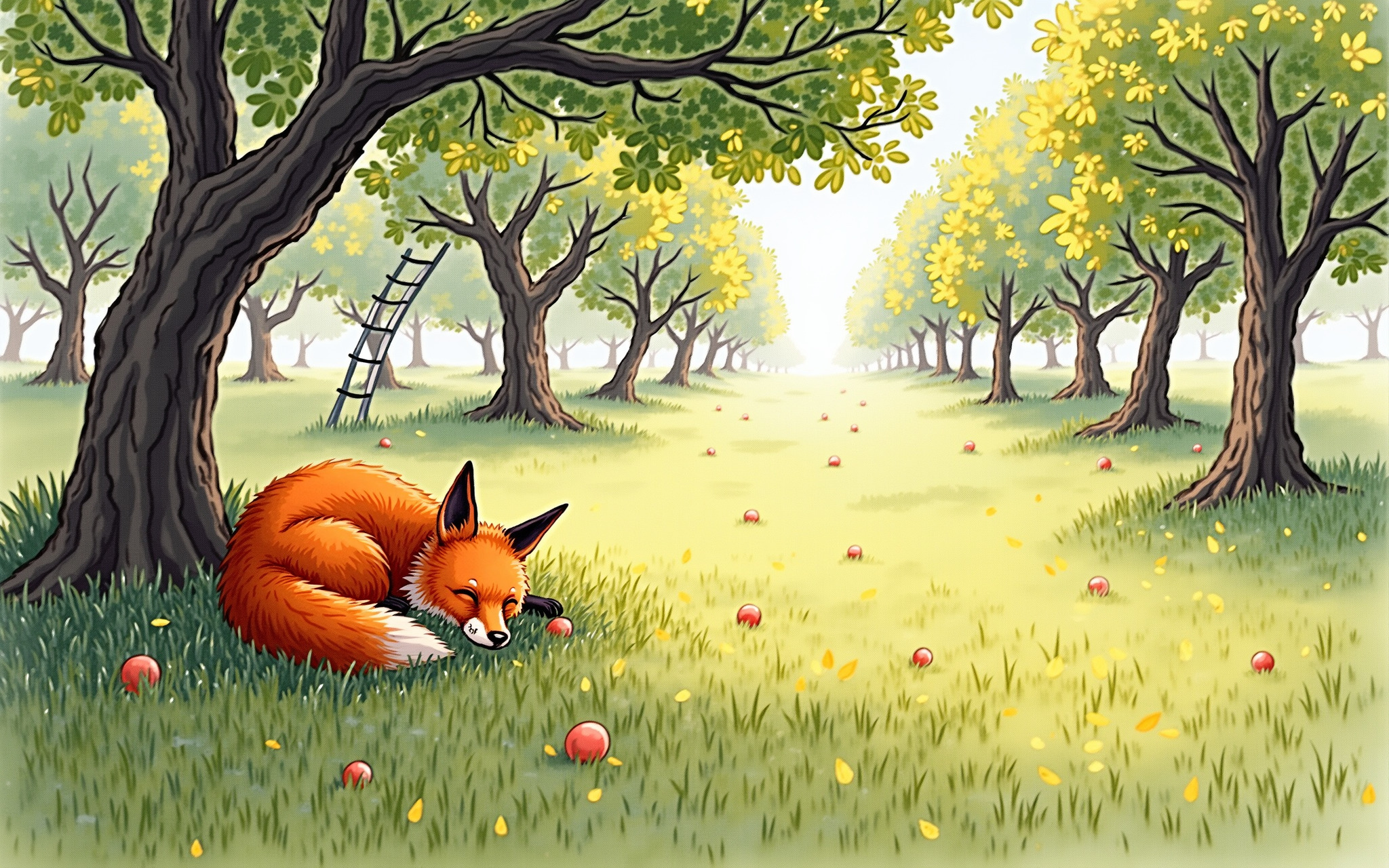
a red fox curled asleep in the long grass, a ladder nobody moved, windfall fruit down the rows · 42.2 s
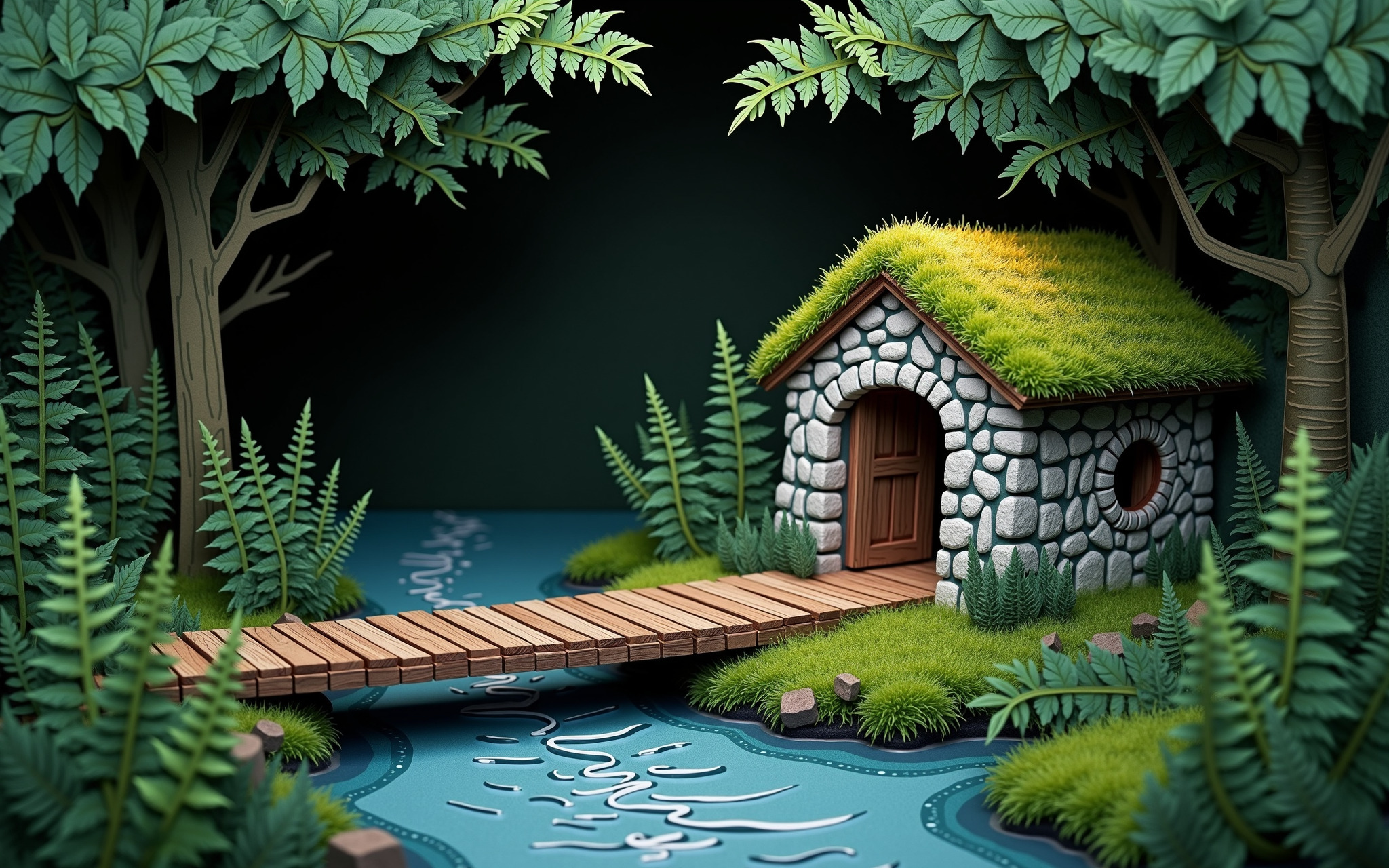
a moss-roofed stone hut with a round window, a plank bridge over a teal creek, ferns taller than the bridge · 41.2 s
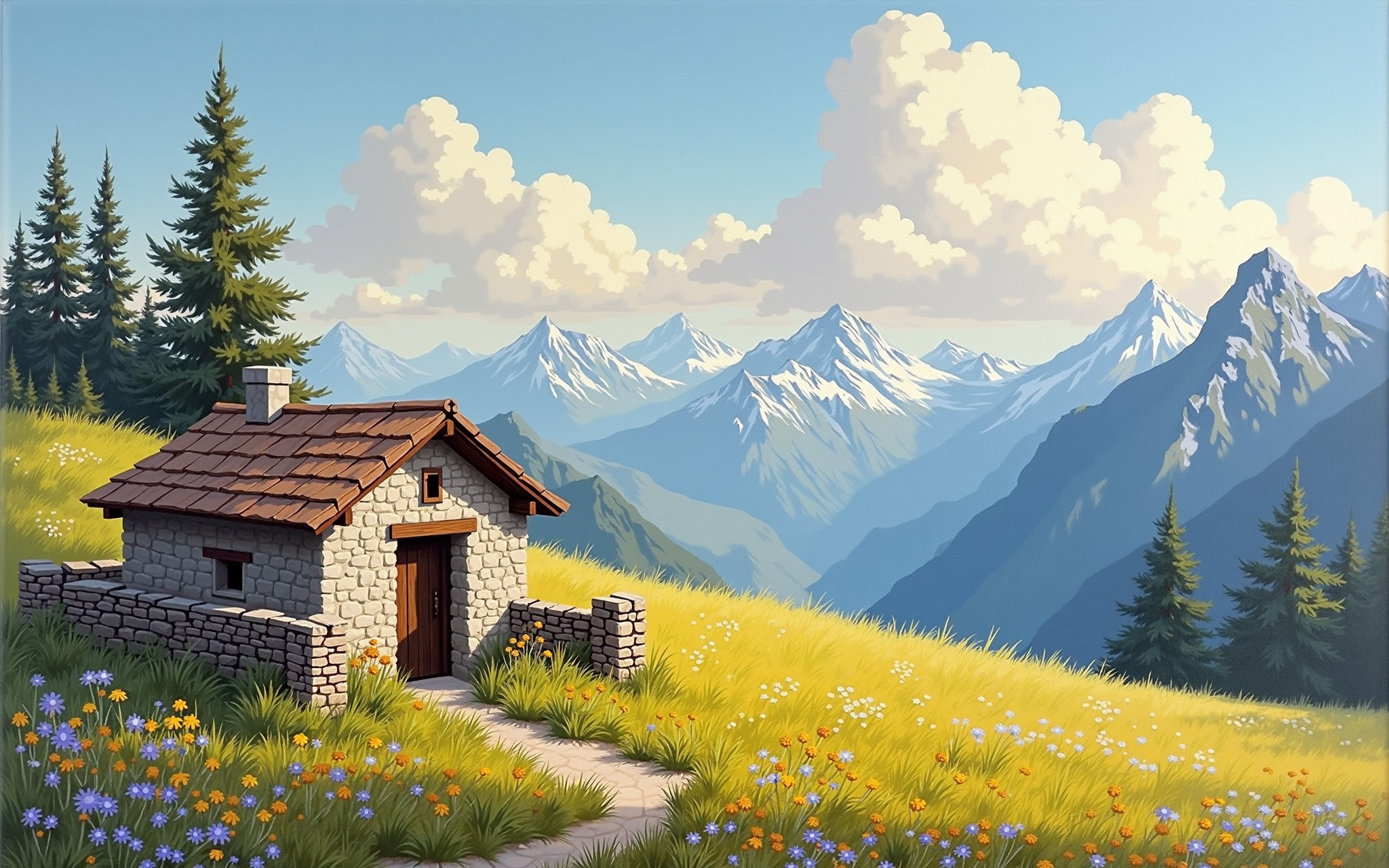
a stone hut with a wooden door inside low dry-stone walls, a wildflower meadow, conifers, a far line of snow peaks · 41.1 s
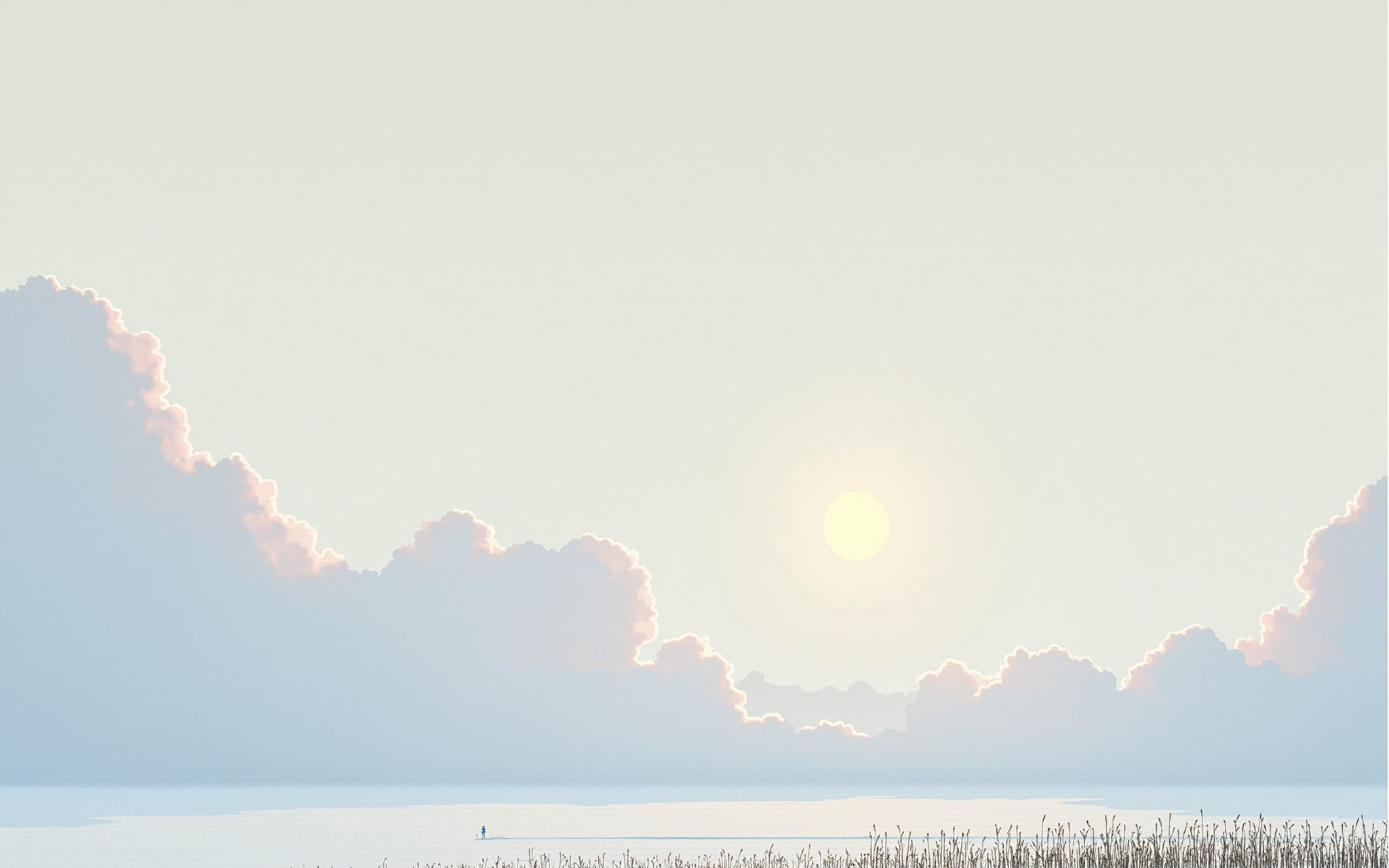
a sky that is most of the picture, a small sun in a gap between cloud banks, reeds along the bottom, and one tiny figure out on the ice · 41.0 s
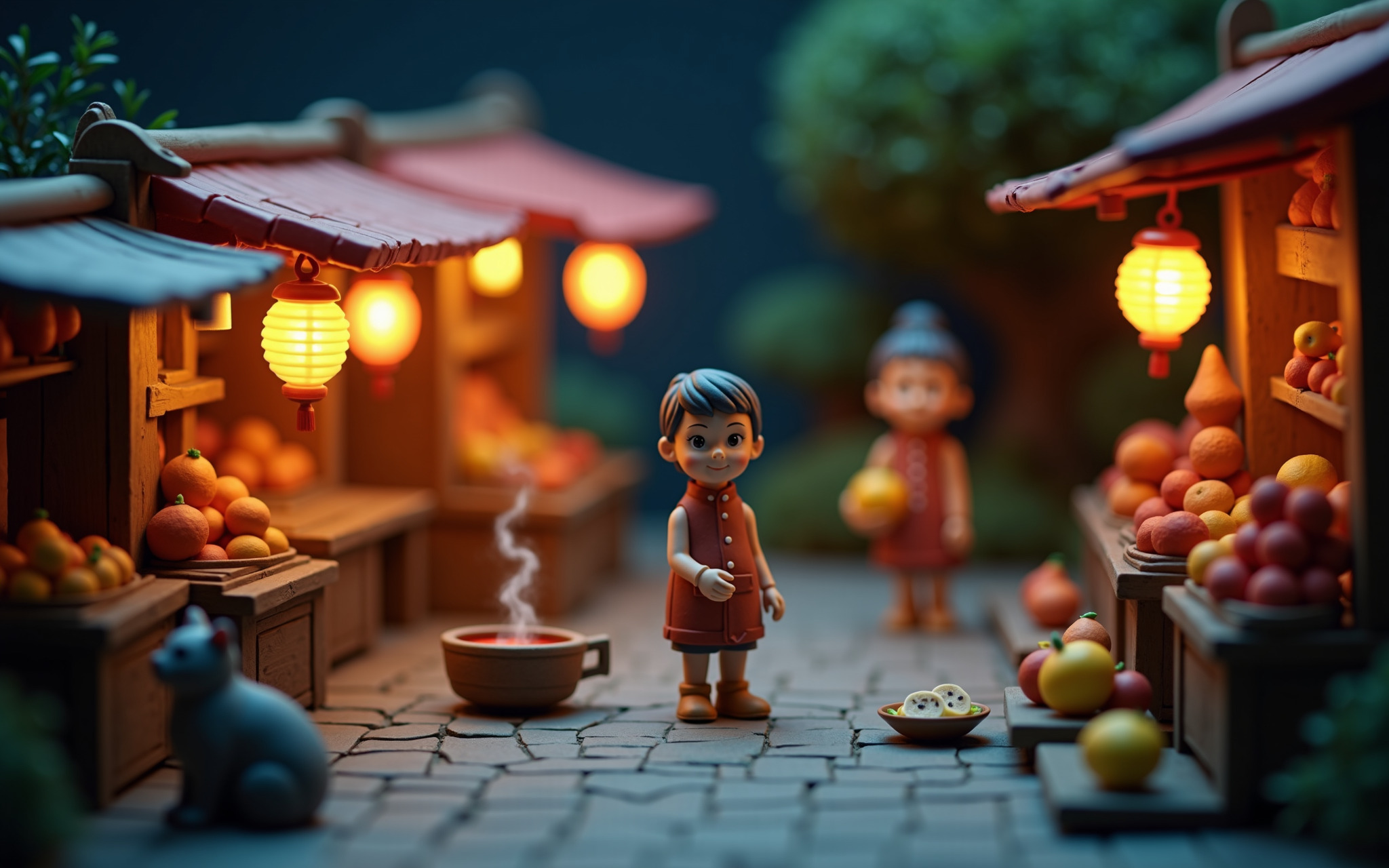
clay stalls under paper lanterns, a steaming pot and a dish of dumplings on the paving, a grey cat, and two clay figures who were not asked for · 41.1 s
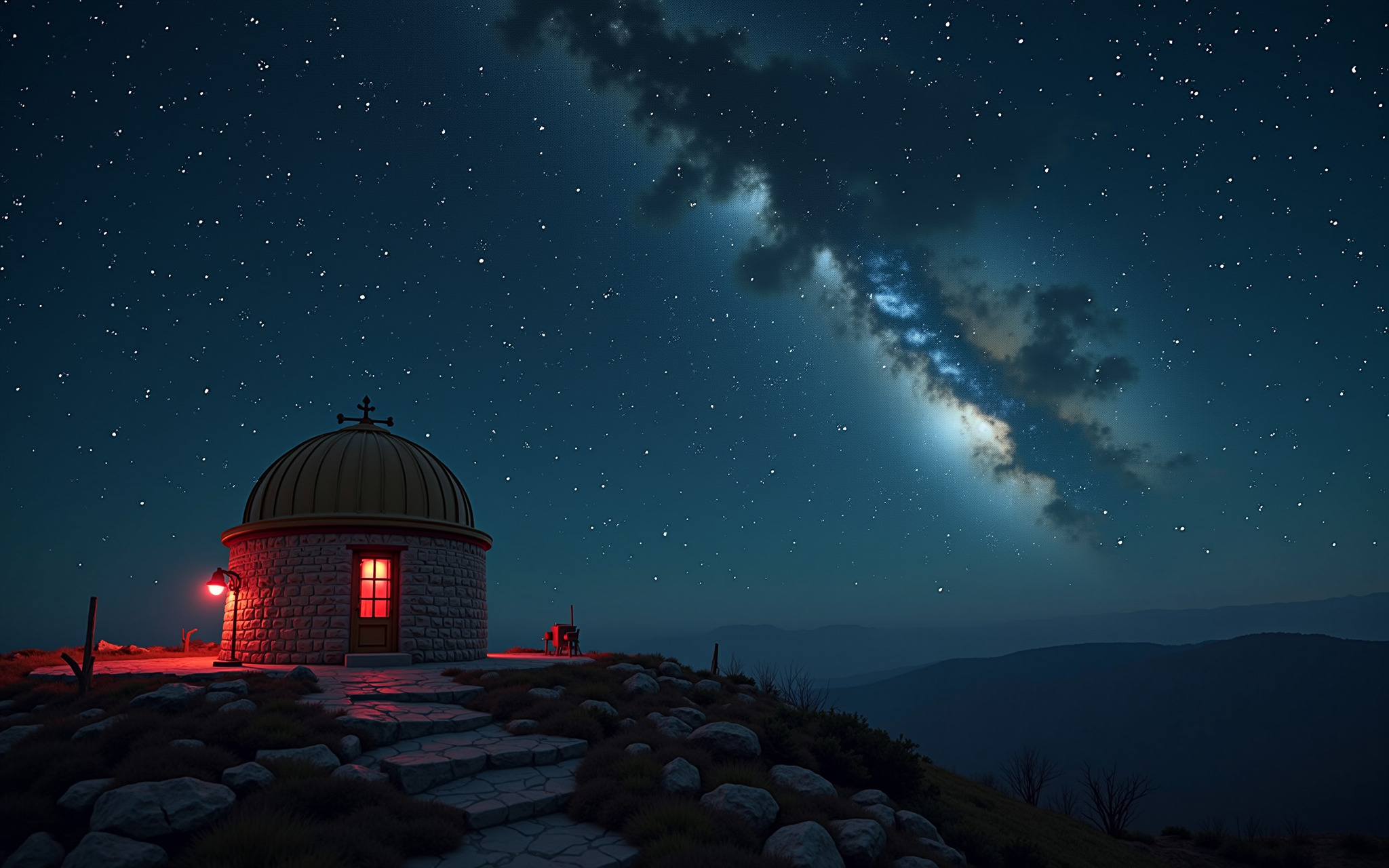
a small round stone building under a shut metal dome, on a rocky hilltop; a red lamp on its post and, past it, a red-lit door; the Milky Way falling away to the right · 41.3 s
Two notes
Night market is colorized claymation: smooth plasticine sets under studio light, a shallow focus that makes a square of stalls look a hand's width across. The request asked for no people. One seed obeyed; the other let in a clay child, and a second figure behind him holding a round gold fruit — the better picture, and clay figures in a clay world are not what the no-people rule was written against. That rule was ours, for these six paintings, and not the lab's; this page is a gallery, and the gallery took them both.
Quiet observatory was asked for as painted light and came back as very nearly a photograph — real stone, a real lens's bloom on the red lamp, a canvas weave over the top. It is not the only skin that bent at this size: still orchard's ink and wash came back flat cartoon, with the wash left only in the far rows, and high pasture's thick brushwork came back airbrushed under a canvas weave. Three of the six captions say so in two halves — as asked, then as painted. The request asked for the dome open to the sky. Both seeds shut it, and the shut dome is the better picture.
How the exhibit closes
None of these paintings will hang in the lab. What will hang there is smaller and shared: every tile a visitor makes, in any of the worlds, lands in the next open slot of one board of a hundred and forty-four — a set — and the hundred and forty-fourth tile freezes it on the spot. Then it cures for seventy-two hours in public, clock on the page: every tile is shown to the picture-reading model once more, one of us looks at all hundred and forty-four on one screen, and anyone can report a print. A tile withdrawn during the cure does not reopen its slot; it becomes a void, a marked blank with its slot number and the day, and it stays a void in the finished piece. At the end of the cure the board is composited into one tapestry, twelve by twelve, voids included, and the sealed page opens by playing the tiles landing, day band by day band, over about twenty seconds. Your own browser lights the ones you made and tells nobody, including us. That is what a world in the lab is for: not a wall of paintings, but a tapestry of strangers' small pictures that closes itself, keeps its holes, and is never renumbered. The paintings above are what the worlds look like when one picture is allowed to be the point.
And this is only a first hanging. Six worlds and one way in — a tile, up to three a day — is how the exhibit will open, not how it ends: more worlds will hang, each arriving with its own page and its own receipts, the way these did.
For the technically curious
Everything here came off our 96 GB workstation-class card in one afternoon: FLUX.1-dev at 2048×1280 and 40 steps, 41.0 to 42.2 seconds per painting by the render engine's own clock, the same recipe as last week's dog. Each request is subject, then place, then style, and the style half is the world's own signature fragment, written to one shape for all six.
Thirty-nine renders were made to choose these six: at least two seeds for every world, and other subjects and other worlds tried along the way and set aside by eye. Every one of the thirty-nine is in the kit by prompt, seed, size and fingerprint, with the six that were chosen marked. The kit is at data/.
Two of the six carried an invented painter's signature in the bottom margin — high pasture and glass tundra. Sixty pixels were cut from the foot of each and the frame was resized back to 2048×1280, a stretch of just under five percent that the kit records and whose uncropped originals it carries. Nothing inside any frame was retouched: the fox's muzzle in still orchard carries a scrawl of invented ink the painter put there, and it stays.
One thing this page cannot say, and last week's page said wrongly until 2026-09-04: that FLUX.1-dev's licence covers sharing these pictures. Our own licence ledger holds that painter as held, because its non-commercial licence grants the outputs in one clause and restricts use in another, and we could not satisfy ourselves which governs. The ledger asks for a professional's reading. Until one arrives these pictures are research receipts — the ledger's own line for them since 2026-09-04, and last week's page now carries the same correction — and we ask you not to treat them as cleared for anything else.
No gate, no verdict, no threshold table. The eye that picked was one of ours, and the kit exists so you can disagree with it in full.
Who ran this, and thanks
The worlds here were written by the same small team that builds the print lab. The painters: FLUX.1-dev for the six on this page, under its non-commercial licence, whose row and our hold are on the licence ledger, and FLUX.2 klein 4B (Apache-2.0) — the lab's own small painter — for three candidate renders that are in the kit. Beneath them: ComfyUI (GPL-3.0), the render engine that ran every pass, and the workflow graphs the estate keeps for it; PyTorch (BSD-3-Clause) over CUDA (NVIDIA, proprietary — the one closed piece, and it comes with the card); Pillow (MIT-CMU), which encoded every picture on this page, cropped two margins, and cut four thumbnails. None of them owed us anything. One of us picked the pictures — how that works is next door.
The rest of the shelf
How the print lab works is the door into the room these worlds were painted for. Last Friday's page, Nine Worlds, One Dog, is the same painter with a very different subject. The benches are one shelf up. This page holds the worlds.