The bench — what this page meters, over which days, and what it cannot see
What it costs to run a high-end AI rig at home
exhibit seventy-two The bench
Published 2026-10-06 (UTC)
A small (human) team and a fleet of AI agents.
What it costs in electricity to run AI models at home, read off a meter on every one of a small workshop's computers: the box with graphics cards that now runs around the clock, about 130 W doing nothing, a measured week, what one picture, one answer and one mini PC cost, and what the meter cannot see.
hardware on this page: RTX PRO 6000 Blackwell (96 GB) · RTX 3090 (24 GB) · RTX 5090 Laptop GPU (24 GB) · RTX 3090 Ti (24 GB) · RTX 5080 (16 GB) · the mini PC → research.strata2signal.com/hardware/ · the roster is in beta, still being tested
the short version
This page is what it costs in electricity to run AI models — pictures, answers, music — on a small workshop's own computers at home, read off a meter on every one of them. The one box with graphics cards that now runs around the clock drew about 130 W doing nothing over 2026-10-04 (UTC), about $17 a month at the average U.S. price (since 2026-10-05 it has read about fifteen watts higher, cause not yet found). Everything together, the work and the test runs included, averaged 76 cents a day over the measured week 2026-09-28 → 2026-10-04 (UTC), about $23 a month, about a seventh of an average American home's electricity. One answer costs about six thousandths of a cent, and a mini PC with no graphics card runs the same kind of model for about $1.44 a month. Here is the meter, and what it cannot see.
11,376 words, about 52 minutes to read.
The summary is this page’s own.
If you're new here: strata→signal is a small workshop (plus a friendly dog with a white patch) that runs AI models on its own machines rather than on a cloud service's, and writes up what it measures. This page is about the electricity those machines use. Every measured number on it came off a meter or a bench (a bench is a measured test run); the few published figures it borrows, the price of electricity and an average home's use, are marked in the table near the end, and the section after the table says how to check. The technical words it leans on are explained where they first appear.
The bill in dollars, before anything else
Everything below is watts and watt-hours for the computers on one shelf in one room of a house — four of them in September, and since 2026-09-27 the answer box (a box with two graphics cards) and a mini PC around the clock, with a bench box that comes on when there is work for it — and nobody has a feel for watt-hours, so here are the same numbers as money at one national rate. The average price of electricity to an American home was 18.31 cents a kilowatt-hour in July 2026 (U.S. Energy Information Administration, Electric Power Monthly, table 5.6.A, the edition released 2026-09-24), and the average American home used 10,791 kilowatt-hours in 2022, about 899 a month, by the same agency's residential-customer FAQ, the latest year it publishes. Neither is our bill or our house; those two numbers are not on this page, because they would say where we live. The machines are named, one row each, in the table under How the workshop runs now, and the week behind the headline figures, day by day, is in the block Measured again, 2026-09-28 00:00 UTC → 2026-10-05 00:00 UTC further down.
- The box that never switches off, doing nothing: about $17 a month. Everything, measured over seven days: 76 cents a day, about $23 a month. Since 2026-09-27 the answer box, one box with two graphics cards, has been the only box with graphics cards running around the clock, and doing nothing it drew about 130 W at its battery backup unit's output, the meter this page uses: 128 W by the median of 1,335 readings over 2026-10-04 00:00 UTC → 2026-10-05 00:00 UTC, which is about 3.1 kilowatt-hours a day and about 92 a month. (Since 08:29 UTC on 2026-10-05 it has read about fifteen watts higher with its cards unchanged; the section on how the workshop runs now has the readings.) The mini runs around the clock beside it, below what its meter can show. Everything else — the work that box did, and the hours the bench box was switched on for measurements — landed on top: about one kilowatt-hour a day, about 19 cents, over the seven days 2026-09-28 → 2026-10-04 (UTC), the first seven whole days the shelf has spent in its present shape. The whole measured day averaged 4.13 kilowatt-hours, about $23 a month. For scale: the living room below — a 55-inch television, a sound bar, an original PlayStation 5 playing Fortnite and the LED lights, used six hours a day — is about 2 kilowatt-hours a day and about $11 a month; the answer box idling around the clock costs about one and a half times that, and the whole measured day about twice. So yes, this workshop still uses more electricity than a living room, and the reason is that it is a company: a research lab, a development shop and a live service (the public things people use), and it keeps a box with two graphics cards awake for that. In September, with three boxes awake, the same line read about $28 a month idling and about $30 measured; that shelf is in the dated sections below, and the drop since then is the bench box no longer running around the clock: in September it made the print lab's pictures all day, and since 2026-09-18 it has come on only for measurements, so its 93 W left the shelf's idle, less the nine watts the answer box's second card added; the second box was already off in that September window.
- One day as the shelf now stands: between 61 and 99 cents. The seven days 2026-09-28 → 2026-10-04 (UTC) ran 5.18, 3.48, 4.19, 5.41, 3.88, 3.32 and 3.44 kilowatt-hours — $0.95, $0.64, $0.77, $0.99, $0.71, $0.61 and $0.63 at that rate — and the dearer days are the ones the bench box was on. In September, with three boxes awake, three clean days — days with the readings nearly unbroken — ran $1.09, $1.01 and $0.95 for 5.97, 5.49 and 5.19 kilowatt-hours over 2026-09-12 → 2026-09-14; with every box awake, 2026-09-07 → 2026-09-09, $1.27, $1.44 and $1.34 for 6.96, 7.85 and 7.30.
- A month at the rate the shelf now runs: about $23, for about 124 kilowatt-hours. That is arithmetic from seven measured days in the present shape, not a measured month. In September's shape it was about $30 for about 167 kilowatt-hours; with all four boxes awake about $40 for about 220; neither of those shelves exists any more.
- A year at the rate the shelf now runs: about $276, that average day times 365, about 1,500 kilowatt-hours, against about $1,980 for the average American home's electricity at the same rate. The shelf as it stands would add about a seventh to an average home's electricity: the average home draws about 1,230 W around the clock, and the shelf averaged 172 W across the seven days, 146 of them the answer box. In September it averaged about 231 W and would have added a fifth; with every box awake about 300 W and a quarter.
- The mini, the box an ordinary person would buy: about $1.44 a month. Its meter showed 76 W while it wrote and nothing at all while it idled; the page that ran it on battery, Two Hours at 12 tok/s — On Battery, puts the real idle near 5 W, an estimate, because that draw is too small for its meter to show. Two hours of writing a day on those figures is about 8 kilowatt-hours a month, under one per cent of an average home's electricity, and even pinned at the meter's lowest showable 27 W around the clock it would be about $3.60. This workshop is a research lab, a development shop and a live service, and needs the bigger boxes. A reader with a mini does not, and their bill would not notice it.
- One picture from the print lab: three hundredths of a cent. That is 1.87 watt-hours at the meter, measured in September on the box that made the pictures then; the box that makes them now is switched off until the weather turns cold, and the figure is dated below. A thousand pictures is about 34 cents.
- One answer at the rules desk: six thousandths of a cent, 0.35 watt-hours — the whole of a twenty-answer window divided by twenty, the pauses between answers included, so a generous reading — or about 150 answers to the cent. A thirty-second beat, 0.66 watt-hours, is about a hundredth of a cent.
- An hour of the shelf doing nothing: about 2 cents as it stands, at 128 W; about 4 cents in September, at 212 W; and about 5 cents with every box awake, at the 270 W the four boxes drew idle. Of the answer box, about seven eighths of its seven days was the box sitting there warm — 3.07 of its 3.51 kilowatt-hours a day, 56 of its 64 cents — and everything it answered and played cost the remaining eight cents a day, so its idling uses about seven times the electricity of all its actual work, where September's shelf said eleven and the busier days before that said eight. Of the whole shelf's week, idling was about three quarters; the rest was the bench box's hours and the work.
Why this page exists
A relative of ours builds websites for a living. We sent him a link to a small game we run, the kind you open on a phone and put down again ten minutes later, and he didn't click it. He assumed, reasonably, that a game with a model behind it runs on somebody's cloud, and that opening it would burn credits, or tokens, or whatever the meter is called this year. He wasn't wrong about the world. He was wrong about this shelf, and nothing we could say in a footer was going to change his mind, because a footer is a claim. Three days on a meter is evidence, and a week is better evidence; this page now has both, and the week's holes are printed with it. So here is the meter itself. The game's own cost, a session at a time, is not on it: nobody has metered one, and the list of what the meter does not see says so.
The other reason is the one everybody has in the back of their mind now. "AI" has come to mean a building the size of a town, a lake evaporated for cooling, and somebody's job gone. Some of that is true of the world, and each of the three gets its own paragraph below, where it touches us. But it is not what is happening in the room where this workshop's pictures get made, and the meter is the only thing we have that can show it.
What "local" means, said at a kitchen table
The workshop runs a few small public things, each with its own page: a print lab, an art board where a visitor gives two words and an image model makes three versions of a picture in about eighteen seconds; a rules desk, a board-game rules helper that answers from the rulebook's own words; a beat lab, a drum machine in the browser with a music model behind it; a tour guide, which answers a walker's questions on a walking tour; and the small game above. The answers at the rules desk, the beats in the beat lab and the tour guide's replies are all made by computers in a room in a house, and so were the pictures on the print lab's wall until the box that makes them was switched off until the weather turns cold. When you open one of those pages, your phone talks to a rented web server we administer, and that server passes your words over our own encrypted link to the computers in the room: for most of the products straight to the answer box, the box with the graphics cards, and for one step of the rules desk's work by way of the mini first, which holds the small program that routes a request to whichever box should answer it. Two machines, or three when a request passes through the mini, all ours to run. No AI company is anywhere in that line: no account, no credits, no third-party request, and no meter on the work but the one in that house. The rented server is a real machine in a real data centre with a meter we cannot read, and we count it against ourselves in the section on what this one can't see.
How the workshop runs now
What this section counts, for a reader who scrolled straight here: which of the workshop's computers are switched on, and what the one with graphics cards that runs around the clock drew doing nothing, measured where its battery backup unit feeds it, so the unit's own draw is not in it, one reading a minute, over 2026-10-04 00:00 UTC → 2026-10-05 00:00 UTC. Against the September readings in the sections below, the shelf has gone from three boxes awake, idling at 212 W together, to one box at about 130 W and a mini below its meter's floor.
The machines, by the names this page uses for them everywhere, the September sections included:
| The machine | Switched on | What it does | Its graphics cards |
|---|---|---|---|
| The answer box | Around the clock; since 2026-09-27 the only box with graphics cards that is | Runs the AI models behind every product's answers, beats and tour replies | An RTX PRO 6000 Blackwell (96 GB), bought new, and beside it an RTX 3090 from 2026-09-16 to 2026-09-24, then an RTX 3090 Ti (24 GB), bought new, since 2026-09-25 |
| The mini | Around the clock | Holds the small program that routes model requests, and other housekeeping | None |
| The bench box | Only for measurements, since 2026-09-18; in September it ran around the clock making the print lab's pictures | Serves nothing now; comes on for a bench and goes off after | Two RTX 3090s from 2020 in September; its cards change with the bench, and through the week this page reads it held one RTX 3090 |
| The second box | Off until the house needs heating: off 2026-09-11 → 2026-09-16, on 2026-09-17 → 2026-09-27 to make the print lab's pictures and the beat lab's record sleeves, off since | Nothing while it is off | Two RTX 3090s from 2020 in September; other cards in its eleven days back on, the last of them a single RTX 5080 |
| The laptop | Awake nearly all week, off the shelf | Collects the readings; it has no battery unit, so it is outside every total | An RTX 5090 Laptop GPU, counted apart |
As of 2026-10-06 (UTC), one box with graphics cards runs around the clock: the answer box, which has held two cards since 2026-09-16 — an RTX PRO 6000 Blackwell (96 GB), the large workstation card of the September readings, and beside it an RTX 3090 until 2026-09-24 and an RTX 3090 Ti (24 GB) since 2026-09-25. Doing nothing, it drew about 130 W: the median of 1,335 readings over 2026-10-04 00:00 UTC → 2026-10-05 00:00 UTC was 128 W, and 128 W again over 2026-10-03 from 03:39 UTC, the oldest reading the collecting laptop still held when this was re-read at 00:36 UTC on 2026-10-06. Adding a card that idles at about 23 W by its own sensor raised the box by only nine watts over the 119 W it idled at with one card in September; the two readings are weeks apart as well as different shelves, and this page cannot say why. One honest wrinkle, named rather than averaged away: from 08:29 UTC on 2026-10-05 the same box has sat about fifteen watts higher — 142 to 145 W by the hour through the end of that day, 143 W by the whole day's median, and 144 W in the first half-hour of 2026-10-06 — with both cards' own draw unchanged, so whatever it is sits outside the cards. Nobody had found the cause by 00:36 UTC on 2026-10-06; this page prints the day before the step as the idle figure, and puts the step in the table and in the list of what the meter cannot see.
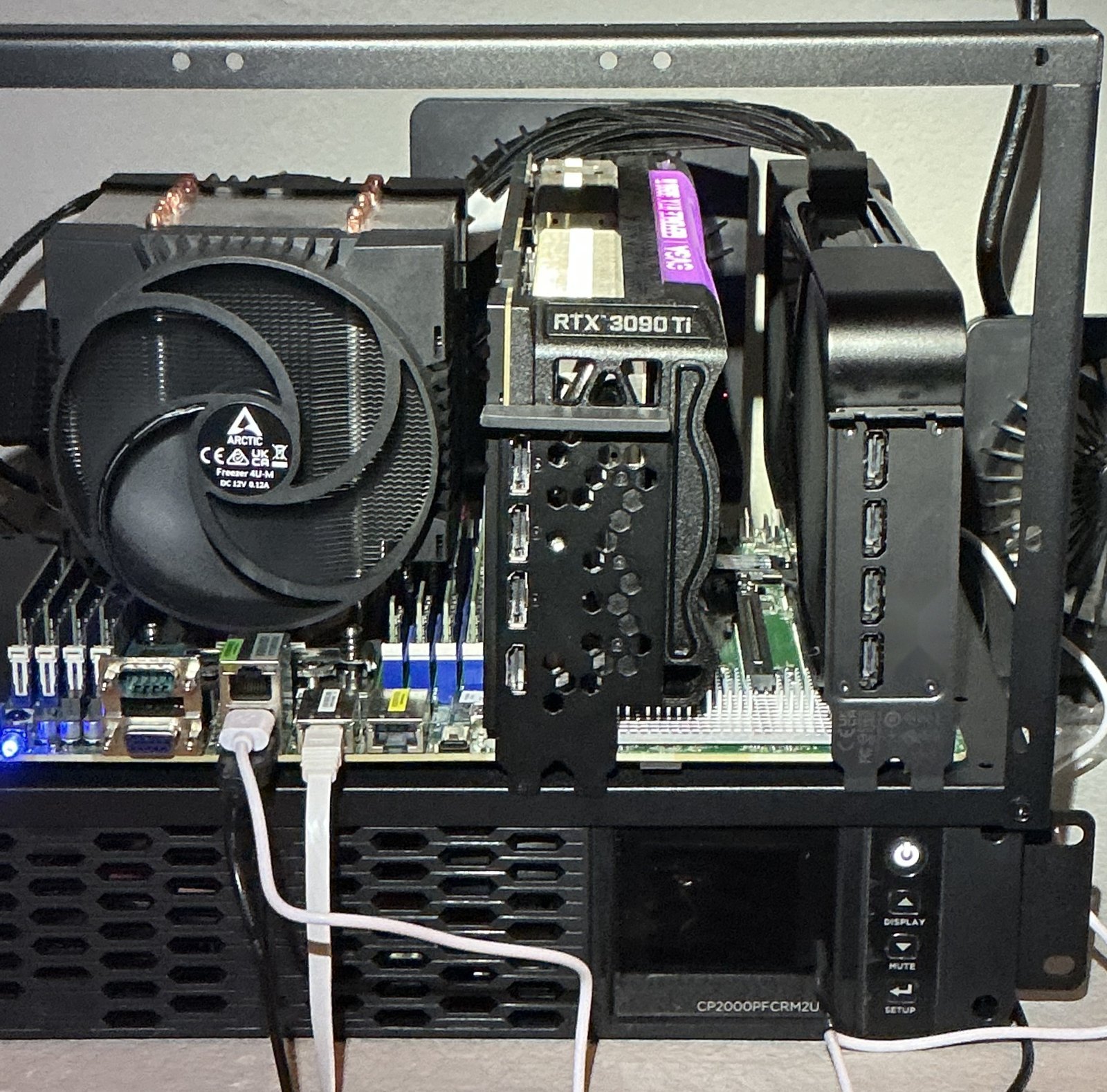
The mini, which has no graphics card, also runs around the clock: it holds the small program that routes model requests, and other housekeeping, and on every day since 2026-09-28 it has drawn below its meter's 27 W floor — a zero on all but two to eight of each day's 1,308 to 1,335 readings, and never above 46 W. So two machines on the shelf run around the clock, and only one of them has graphics cards; the meter can price that one and not the other. The laptop that collects the readings, which has a graphics card of its own, was awake nearly all week too; it sits off the shelf, has no battery unit, and is outside every total.
Everything else switches on when there is work for it. The bench box, which in September made the print lab's pictures, serves nothing now: it comes on for a measurement and goes off after, and in the seven days this page reads it was on for parts of four of them — from 10:58 UTC to 21:29 UTC on 2026-09-28, and in one continuous run from 18:13 UTC on 2026-09-30 to 04:51 UTC on 2026-10-02 — drawing 4.3 kilowatt-hours over those hours. The second box, the one switched off on 2026-09-11 because it was heating the room for nothing, came back on 2026-09-17 with other cards to take over the making of the print lab's pictures and the beat lab's record sleeves, and went off again on 2026-09-27, taking both with it; it comes back on when the house needs heating, and the footnote at the end of this page is about that.
The instrument
Every box on the shelf sits behind its own battery backup unit, and each of those units reports the power it is passing to the box it protects; the unit refreshes the figure about every twelve seconds and the ledger reads it once a minute. That is where "the meter" is on this page: at the unit's output, so the unit's own electronics and charger are outside every figure below, and a plug-in meter between the socket and the unit for one hour is still to be done, to say by how much. One of the four units, the second box's, has since been found answering without measuring, and that box's figures carry a caveat where they appear. Each graphics card reports its own draw every fifteen seconds. A small program — this page calls it the ledger — reduces those readings into one file per day and keeps three rules while it does it: a gap in the readings is counted as a gap and never filled in, whether the collecting laptop missed a minute or a box was switched off on purpose to clean its fans; the day's total is never scaled up from partial coverage; and a box that is switched off is written down as nothing known, not as zero. The readings were already being taken and thrown away after a few days when the program was written to bank them — about six days then, under three by 2026-10-05, because the history is kept to a budget in bytes and the snapshots have grown — so its files reach back to 2026-09-06, the day the history starts, and it has run on its own timer since 2026-09-11.
One of the boxes, the smallest, draws so little that its backup unit mostly cannot see it. The unit reports nothing at all until the box draws about twenty-seven watts, and above that band it resolves single watts — by 2026-09-11 it had reported 27, 28, 29, 34, 36, 38, 39, 46 and 47 and nothing else above zero. Across 10,834 readings of the unit over the nine days 2026-09-06 → 2026-09-14 the mini was above the band in 48, fewer than one in two hundred; across 9,233 readings over 2026-09-28 → 2026-10-04 it was above the band in 37, the same share; and when this was first measured, on 2026-09-11, a different thirty-seven — thirty-seven of that day's zero readings — arrived with the unit's own load channel reading one to three per cent, so a zero is the band and not the box. For that box this page says below the meter's floor, names the floor, and never says zero. A reading of nothing is a fact about the instrument as much as about the box.
What sat on the shelf in September, and what each drew doing nothing
Four boxes, and what each drew doing nothing on the last clean day all four were awake and measured, 2026-09-09 (UTC):
- the answer box, which then held one large workstation card, an RTX PRO 6000 Blackwell (96 GB), and answers every question the workshop's products ask: about 119 W (its median over the day; a live read on 2026-09-12 said 118). It has a second idle: for some minutes after it has worked, the card stays clocked up at about 86 W and the box reads about 220 W before it settles, so the bare number is the day's median and not every minute of it. It has held a second card since 2026-09-16 — an RTX 3090 first, the present RTX 3090 Ti (24 GB) since 2026-09-25 — and idled at 128 W on 2026-10-04; the section above has the window.
- the bench box, which then held two second-hand cards from 2020, both RTX 3090s, and made the print lab's pictures on one of them: about 91 W on that day, and 93 W by the medians of the three clean days after the second box went off. The second card drew 0.59 of a kilowatt-hour that day doing nothing at all, and 0.58 to 0.59 on each of the three after. It serves nothing now, and its cards change with the bench.
- the second box, which that day held two RTX 3090s from 2020, and which we switched off on 2026-09-11 because it was drawing power and heating the room for nothing: 57 W idle that day. Read that figure as a floor. Its own unit has read unusually close to its two cards' own draw — on 2026-09-09 the 57 W leaves about 13 W for everything in the box that is not a card, where the bench box, built the same way, leaves about 44 — and on 2026-09-18, with other cards in the box, the workshop found that unit answering without measuring: 121 to 122 W whatever the box did, across a 335 W swing. It came back on 2026-09-17, with other cards, to take over the making of the pictures, and went off again on 2026-09-27 until the weather turns cold; on every day file outside those eleven days the ledger has written nothing known in its column. What it was costing is measurable from before it first went, with the same caveat: its own last three clean days averaged 1.77 kilowatt-hours, about $9.70 a month.
- the mini, a mini PC with no graphics card at all: below the meter's 27 W floor
Together, on a day when all four were awake, that is 267 W measured plus whatever the mini draws under the floor — call it roughly 270 W, a floor by the second box's caveat. With the second box off, 212 W by the medians of the three clean days that followed — 119 W and 93 W, and a box below its meter's floor. A live read on 2026-09-12 put the two remaining boxes at 118 and 99; the medians are the figure this page uses. As the shelf stands now, 128 W and a box below its floor. For a comparison most people can picture: a living room in the evening — a 55-inch LED television at about 80 to 100 W, a sound bar at 20 to 50 W, an original PlayStation 5 playing something like Fortnite at about 200 W and a string of LED lights at 10 to 20 W — draws about 325 W together by their typical ratings, and used six hours a day, which is a conservative day for a household with a gamer in it, is about 2 kilowatt-hours a day, about $11 a month at the national rate. The answer box idling draws about two fifths of that room switched on; the difference is hours, not watts, and the table puts the three shelves this page has measured beside the room:
| The shelf | When (UTC) | Idle, W | Idle: kWh a day · $ a month | A whole measured day: kWh · $ a month | The whole day ÷ the living room's day |
|---|---|---|---|---|---|
| Every box awake, four of them | 2026-09-07 → 2026-09-09 | ~270, a floor | 6.5 · ~$36 | 7.37 · ~$40 | 3.8 |
| Three boxes awake | 2026-09-12 → 2026-09-14 | 212 | 5.1 · ~$28 | 5.55 · ~$30 | 2.8 |
| Now: the answer box and the mini around the clock, the bench box on demand | Idle 2026-10-04; the week 2026-09-28 → 2026-10-04 | 128 | 3.1 · ~$17 | 4.13 · ~$23 | 2.1 |
| The living room, six hours an evening | Typical ratings | 325 switched on | — | 1.95 · ~$11 | 1 |
One box alone, the bench box at 91 to 102 W by its September readings, would be about 2.2 to 2.4 kilowatt-hours a day, about $12 to $13 a month, about the room; the rest is what running a company on the shelf costs over running a hobby on it. The workshop is not only this room: a rented machine serves the public pages and a second runs the game, nothing here meters either, and they are in the list below.
One clean day
The meter has three clean days with all four boxes awake and the readings nearly unbroken: 2026-09-07, 08 and 09, at 6.96, 7.85 and 7.30 kilowatt-hours. The one this page reads is 2026-09-09, the middle of the three by total, the busiest of the window for the answer box's card, and the one with the smallest gap — about a minute in the whole day. The shelf drew 7.30 kilowatt-hours at the meter. 53% of that came out of the five graphics cards inside those four boxes, and about two thirds of the cards' share was the cards sitting warm rather than working. The bench box's picture card was above a hundred watts for a little over one part in a thousand of the day, against an idle of 23 W; the answer box's large card was above a hundred watts for about 6% of the day — 6.05% on this day, 1.79% on the next — and idled at about 30 W the rest of the time. A sixth card, in the laptop that collects the readings, drew another 0.30 kilowatt-hours that no meter here can see. The 53% divides what the cards report of themselves by what the units report at their output, so the cards' true share of the day is a little higher, nearer 59%, because each box's power supply loses about a tenth on the way to the card; the page keeps the smaller number because it is the one the two instruments agree on.
Seven kilowatt-hours is about three loads in a tumble dryer, or about twenty-two hours of that living room switched on. At the national average rate in the section at the top, 18.31 cents a kilowatt-hour, that is about a dollar and thirty-four cents. Money is a cost to us and not to the world. The other unit is carbon: at a grid average of about 400 grams of carbon dioxide per kilowatt-hour — a round mixed-grid figure, because our own grid's published number would say where we live — the day is about three kilograms. Grids differ from one another by more than a factor of two, the round figure sits on the unflattering side of most of them, and it is in the table marked as not measured here. And every one of those watts became heat in the room: 270 W is about nine hundred British thermal units an hour, and in summer an air conditioner spends a fraction again removing it, a fraction this page does not multiply by because no meter here reads the air conditioner. In winter some of that heat may do the heating's job, and the footnote at the end of this page is about that.
The month and year figures at the top are arithmetic from seven measured days, not a measured month or year; a measured month gets its own dated block here when the meter has one with the same machines on. And the shelf measured in this section is not the shelf that exists now: the second box, the 57 W one above, went off on 2026-09-11, came back for eleven days from 2026-09-17 to make pictures, and has been off since 2026-09-27; what the shelf that exists now draws is in the dated blocks below. What can be said of this one: with every box awake the shelf's day sat between about 7.0 and 7.9 kilowatt-hours, and a month at that rate would be somewhere around 220 kilowatt-hours, for a shelf that no longer exists in that shape — arithmetic, not a measurement, and not in the table for that reason.
Measured again, 2026-09-12 00:00 UTC → 2026-09-15 00:00 UTC. What follows counts the same thing the rest of this page counts — the electricity the computers on one shelf in one room drew, measured at their battery backup units' outputs, one reading a minute — over the three clean days after the shelf first changed shape. The second box went off on 2026-09-11, so these were the first days the meter read the shelf without it. Against the three clean days above, taken 2026-09-07 → 2026-09-09 with every box awake, the shelf's day fell from an average of 7.37 kilowatt-hours to 5.55, about a quarter less.
The three days ran 5.97, 5.49 and 5.19 kilowatt-hours — $1.09, $1.01 and $0.95 at the national rate in the section at the top, $1.02 a day on average — with gaps of 7.2, 0.3 and 1.1 minutes, none of them filled in. The two boxes still awake idled at 119 and 93 watts by those days' medians, 212 together, and the smallest box stayed below its meter's 27-watt floor throughout. The answer box's median is the same 119 it read before the change, and it drew 3.24 kilowatt-hours a day; the bench box drifted up two watts from 91. At 212 watts the shelf doing nothing is 5.1 kilowatt-hours a day, about $28 a month; everything the machines actually did — the pictures, answers and music — added 0.46 of a kilowatt-hour a day on top of that, about eight cents, and the three days' work ranged from 0.86 down to 0.10 of a kilowatt-hour, which is the honest size of the swing. The whole measured day averaged 5.55 kilowatt-hours, about $1.02, about $30 a month, about $370 a year — a fifth of what the average American home uses, where the shelf with every box awake would have been a quarter. Nine tenths of it was still the machines sitting there warm: the idling used about eleven times the electricity of all the work, where the older and busier days said eight.
Three cards sat inside the two boxes the meter read, and 48 per cent of those three days came out of them, against 53 per cent from five cards before; the same correction for the power supplies that made 53 into 59 makes this one nearer 53. The card that made the print lab's pictures was above a hundred watts for about 1 per cent of each day, against a little over one part in a thousand on 2026-09-09 — the lab had readers by then — and the answer box's large card ranged from 9.7 per cent of the day above a hundred watts down to 2.0.
The rest of the change was the box that went off. Its own last three clean days averaged 1.77 kilowatt-hours a day, about $9.70 a month and $118 a year at the same rate, a floor by the caveat above, and that is the whole of the drop. From 2026-09-11 to 09-16 the ledger wrote nothing known in its column on every day file, with the ruling that switched it off, the date, and the condition that would wake it again recorded in the file beside the blank; on 2026-09-17 the box came back and the run of clean days was already over — 2026-09-15 was a fourth clean day at 5.20 kilowatt-hours, and 2026-09-16 lost sixty-nine minutes of the answer box to a gap — which is why this block is three days and the next one starts where the shelf settled again.
Measured again, 2026-09-28 00:00 UTC → 2026-10-05 00:00 UTC. What follows counts the same thing the rest of this page counts — the electricity the computers on one shelf in one room drew, measured at their battery backup units' outputs, one reading a minute, every hole written as a hole — over the first seven whole days the shelf has spent in its present shape: the answer box with two graphics cards and the mini around the clock, the bench box on when it had work, the second box off until the weather turns cold. Against the three clean days above, 2026-09-12 → 2026-09-14 with three boxes awake, the shelf's day has fallen from an average of 5.55 kilowatt-hours to 4.13, about a quarter less, while the answer box rose from 3.24 to 3.51 kilowatt-hours a day with its second card.
The seven days ran 5.18, 3.48, 4.19, 5.41, 3.88, 3.32 and 3.44 kilowatt-hours — 28.9 over the week, 4.13 a day on average, 172 W around the clock — $0.95, $0.64, $0.77, $0.99, $0.71, $0.61 and $0.63 at the national rate at the top, 76 cents a day, about $23 a month and about $276 a year, about a seventh of what the average American home uses. Two of the seven carry holes larger than any on a day this page had counted before, and the bar the block above set would have thrown both days out: 2026-09-29 lost 13.5 minutes of every box that was on when the collecting laptop missed its readings, and 2026-10-03 lost 27.5 minutes of the answer box, a single 26-minute hole around the box being switched off on purpose to clean its fans, written down as unknown and never as zero. Neither hole is filled in; at the box's idle draw the larger one is about 60 watt-hours, under two per cent of that day. The ledger's rule is that a gap stays a gap, and this page would rather print a week with two holes it can name than wait for a week without any. By the stricter bar the block above set — no day with a hole beyond a few minutes — the longest run the meter holds is three days again, 2026-09-30 00:00 UTC → 2026-10-03 00:00 UTC, at 13.5 kilowatt-hours, 4.49 a day, with the bench box on for about half of it, from 18:13 UTC on 2026-09-30 to 04:51 UTC on 2026-10-02; a reader can take either figure, and both are in the table.
The answer box drew 24.6 kilowatt-hours over the seven days, 3.51 a day, 146 W around the clock: about 64 cents a day, about $19 a month, about $235 a year, about twelve per cent of an average home's electricity on its own. About seven eighths of that was the box sitting there warm — 128 W around the clock is 3.07 kilowatt-hours a day, by 2026-10-04's median applied to all seven days — and everything it answered and played was about 0.44 of a kilowatt-hour a day, eight cents, so the idling costs about seven times the work. The bench box drew 4.3 kilowatt-hours over the parts of four days it was on, 0.62 a day averaged over the week. The three cards in those two boxes drew about half of the week — 49.5 per cent, counting the cards by their own sensors against the boxes by their units, nearer 55 with the power supplies' losses — and the mini stayed below its floor on every one of the seven days.
A week with no hole longer than a few minutes cannot be complete before 2026-10-11 00:00 UTC, counting from 2026-10-04, and that is arithmetic, not a forecast; when the meter has one, it gets its own dated block here.
What one thing costs
Where no meter was read during the thing, an "at the meter" figure in this section is built the same way: the box's idle draw, plus the card's extra draw while it works divided by 0.9 for the power supply's losses, times the seconds the thing took. The card figures are what the card reported of itself: for the picture, the whole draw, because the card is sitting on its cap doing nothing else; for the language work, the draw above the card's idle, because the card is answering in the middle of an ordinary day. Where the box's own meter was read during the thing, the table says so; where it was not, the row says what stands in for it. These were measured in September, on the shelf as it stood then; the box that makes the pictures now is off until the weather turns cold, the answer box has a second card now, and each row is dated.
A picture. A visitor gives the print lab two words; models read the words three times before anything is made; the image model makes three versions of the picture, called plates, in about eighteen seconds; the visitor keeps one or none; and a model that reads pictures checks a kept one three times before it hangs on the board. On the bench, with the card warm, a batch of three plates takes 18.5 seconds with the card sitting on its power cap of 250 W (a cap is a limit we set below the card's rating; the section after this one has them): about 1.3 watt-hours at the card — the seconds measured, the watts measured, the watt-hours their product. The lab's own budget charges each visitor twenty-two seconds a picture, the slowest batch of that bench, rounded up, but the energy here is the seconds it actually took. At the meter it is 1.87 watt-hours, read off the box's own meter during a fresh batch of twelve on 2026-09-12 — 18.3 seconds a batch, 367 W at the meter against 102 W idle that minute. In kitchen units that is three and a bit seconds of a 2,000 W kettle (a European kettle; most American ones are nearer 1,500 W), or eleven minutes of a 10 W bulb. The three readings of the words cost about 3% of that on top, and the 3% is a floor: only one of the three calls, the word gate, has been timed, and the third reads a longer prompt. The three readings of a kept picture — about 5.8 seconds of a card's time by the lab's own bench, roughly 0.4 watt-hours at the card — mean a kept picture costs about a third again on top of the picture itself. The reading is cheaper than the making, and it is not free. The making of the pictures moved to the second box on 2026-09-18 and went off with it on 2026-09-27; while that box is off, no pictures are being made, and this is the September figure.
An answer. The answer box's card, while it is generating words, draws about 290 W, not the 450 W it was allowed on 2026-09-12 — its cap has been 420 W since later that month — because writing words is bound by how fast the card can read its own memory rather than by arithmetic. A token is the piece of a word a language model writes in, about three quarters of an English word on average, and a joule is one watt for one second. Measured on 2026-09-12 at 206 tokens a second, that is 1.4 joules per generated token; a bench in August read 1.67 at 304 W, and the model server has got faster since. Twenty real questions from the rules desk, asked one after another with the box's own meter beside them, came back at a median of 293 tokens. An answer that length costs 0.18 watt-hours at the card and 0.35 at the meter by the generous reading this page uses — the whole of the twenty-ask window divided by twenty, the two-second pauses between asks and the box's own idle included; over the box's idle alone, the work itself, it is 0.14 and 0.20. The 0.35 is a little over half a kettle-second, the electricity a 2,000 W kettle uses in a second. Even counting the whole six seconds an answer took on the three occasions anyone timed one whole, all of it at full generation draw, it is 0.7 watt-hours at the meter, a little over one kettle-second, and that is a ceiling, because the seconds before the words start are retrieval and reading, not generating. One thing those twenty asks did not carry is the rulebook passages a real ask arrives with, so the seconds before the first word are not yet measured.
A walker's question on a tour. The tour guide, on its ordinary production path over a real prompt of six and a half thousand tokens, answers in about 1.1 seconds at the median: roughly 0.08 watt-hours at the card and 0.13 at the meter by this section's rule — about a fifth of a kettle-second.
A beat. The beat lab's music model makes a thirty-second clip in about 11 seconds on the answer box's card, and the card, sampled through it on 2026-09-12, sat at a median of 87 W and peaked at 149 — nowhere near its cap, 450 W that day and 420 now. The clip costs 0.26 watt-hours at the card and 0.66 at the meter; the whole fresh process it runs in, twenty seconds, costs 0.5 and 1.2. The model's own clock says the making of the sound takes six tenths of a second, and eight of the eleven seconds are the model moving its weights — its learned numbers, gigabytes of them — between the processor and the card. An estimate from the cap alone had put the beat at 1.3 watt-hours, two to five times too high.
The mini. The box the meter mostly cannot see runs a 26-billion-parameter language model (a parameter is one of a model's learned numbers) on its processor alone at about twelve tokens a second — 12.66 the first time it was timed, on 2026-08-25, and 12.0 on mains during the battery run of 2026-08-31 — which is faster than most people read. We pulled its plug mid-answer once, and it kept writing at 11.87 tokens a second on its backup battery against 12.0 on mains, which is noise; the stretch we measured on battery was six minutes, and the two hours that page, Two Hours at 12 tok/s — On Battery, is named for is the battery unit's own projection from those six. It sits below the meter's floor even while it is doing that: the highest the meter caught it over the eleven days 2026-09-06 → 2026-09-16 was 47 W, and over the seven days 2026-09-28 → 2026-10-04, 46. For the eleven days between, 2026-09-17 → 2026-09-27, that unit's column carried readings far above anything a mini PC can draw — up to 704 W — while the second box was being brought back; this page reads that as some other load on the mini's unit for those days, has not verified it, and uses no figure from them for the mini.
The caps
The two cards in the answer box, and every card in the September readings this page prices, are deliberately held at or below 80% of their ratings. The workstation card, an RTX PRO 6000 Blackwell (96 GB), ran at 450 W of a possible 600 through the September benches and has been held at 420 since mid-September; the RTX 3090 Ti (24 GB) beside it since 2026-09-25 is held at 350 of its 450; the 2020 cards ran at 280 of 350, and the one that made the pictures lower still, at 250, the rule here for work that runs for hours. The cards outside the rule are the bench box's RTX 3090, which through the week's benches ran at 300 of its 350 W, 86%, and the RTX 3090 the answer box held from 2026-09-16 to 2026-09-24, at the same cap. On the bench — on the workstation card, the only one we benched both ways, at the 450 W cap it then had — the cap costs 2% of speed on dense work (a dense model is one in which every learned number takes part in every word) and nothing measurable on the mixture-of-experts models (models built from many small specialists of which only a few run for any one word, so they do less arithmetic per word), and it takes 138 W off the card's busy draw; nothing on this page has benched the 420 W cap. An earlier page here, What 150 Watts Buys, measured the busy draw of that card at about 448 W with a dense model pinned to its ceiling. Both pages are true together: pinned, it drew 448 W; on 2026-09-09, the busiest September day this page reads for that card, it was above a hundred watts about 6% of the time and above 250 W under 5%, and it idled at 30 W; on 2026-10-04 it was above a hundred watts 1.7% of the day and above 200 W 0.2%, and its median was 30 W again.
What the meter does not see
What we know we are not counting:
- The training of the models we run. The image model, the language models and the doorman — the small model that screens what a stranger types before anything answers — were trained by other people on other hardware, and nothing on this shelf metered a second of it. Nobody has published a figure for these particular weights, and we are not going to invent one by analogy. What can be said without a number: training one of these was plausibly more electricity than this shelf will draw in its whole life, it was spent before we arrived, and every kettle-second on this page sits on top of it. A page that measures only the cheap half and calls the total small would be lying by subtraction. This page measures the cheap half.
- The cards' manufacture. No instrument here touches it. Of the cards in the September readings, four were second-hand parts from 2020, which is the honest answer to that particular question: their embodied cost was paid once by somebody else and is being amortised rather than re-spent. The two cards in the answer box now were both bought new, as was the laptop's, and their manufacture is ours to own and impossible for us to count; the second box last ran a single RTX 5080 before it went off, the 2020 cards have moved between the other boxes since September, and the bench box's cards change with the bench — through the week this page reads it held one RTX 3090.
- The rented machines. The public pages, this one included, are served from a virtual server in a hosting provider's data centre, and the game's own server is on another. Neither has a meter we can read. Every kilowatt-hour above is the shelf at home, and the pages you read it on are served from somewhere else.
- The game. The game that started this page runs on one of those rented servers, and the model work behind it has never been metered as a session; this page prices the kinds of work it does, an answer and a picture, and not the game.
- The water. Nothing on this shelf is water-cooled and nothing here evaporates anything: the boxes are cooled by the air in a room and the fans in their own cases, and the only water bill this workshop has is a kitchen tap. The rented machines are a different matter. They sit in somebody's data centre, and what that hall draws for cooling, and from where, is not published to us.
- The carbon. The meter reads watts. What a watt costs the air depends on the grid it came from, and we have not sourced a national figure for that the way the price at the top is sourced, so the page uses a round mixed-grid number, picks it on the unflattering side, and marks it in the table as not measured. Our own grid's published number would say where we live, and that one is not going on the page at all.
- The backup units themselves. The meter is at each unit's output, so the unit's own electronics, its display and its charger are in nobody's total. A plug-in meter beside one unit for an hour is still to be done, and it will also say how far a unit's own report can be trusted: one of the four, the second box's, has already been found answering without measuring, so the second box's September figures are floors, and a reference beside each of the other three is still to be done before any of their columns is called exact.
- The comparison. This page says what the shelf drew. It does not say whether a rented model would have drawn less to do the same work, because that needs a bill and a token count from somebody else's meter beside ours, and that would need its own dated page rather than a paragraph here.
- The fifteen watts. From 08:29 UTC on 2026-10-05 to at least 00:35 UTC on 2026-10-06 the answer box has sat about fifteen watts above the idle figure this page prints, with the cards unchanged; the section on how the workshop runs now has the readings, and nothing here can say what it is.
- The laptop. The computer that collects the readings is a laptop with no backup unit, so its own draw is not in the totals, and because it sleeps, the ledger has holes on the days it slept. Its card is the sixth card: the ledger counts its 0.30 kilowatt-hours on 2026-09-09, and 0.3 to 0.5 a day in the seven-day block, with the cards; the cards' shares above deliberately do not; and no meter here sees the rest of the machine at all.
- The room. No thermometer, anywhere. Every sentence about heat on this page is inferred from watts, and the air conditioning the heat causes in summer is a real cost that the meter never sees. The winter is the footnote at the end.
- The network, the router, the internet provider's equipment, and the phone in your hand.
The part about jobs
Somebody reading this has lost a client to a model like the ones on this shelf. That is the version of this argument that costs money, nothing measured on this page makes it untrue, and a meter can price the electricity a picture took and cannot price the person who used to be paid to draw it. The instrument is silent on the only thing that reader cares about.
What it can say is what happened in this workshop. An operator decides what gets built, what a page is allowed to claim, what a stranger is asked, and what the machines are not permitted to keep; the agents draft and check, an operator reads, and every page here ends with who ran it. The print lab itself did not take a painter's commission: nobody was ever going to be commissioned to sketch a stranger's two words in eighteen seconds for nothing, and that part is a new thing rather than a cheaper way of doing an old one. That defence does not stretch to cover the whole workshop. The six worlds painted large on the page next door, Six Worlds for the Print Lab, are the kind of picture somebody could have been paid to paint, and a model painted them. We cannot answer in our own favour the question of whether anybody would have been paid, so those six are not filed under new things. The model under the lab was trained on work nobody asked the artists for. The back of every print names the model and its licence, and the page about the lab, How the print lab works, says what that licence does and does not settle: it settles what we may run and not whether anyone consented.
Numbers, so it isn't just talk
Every window is UTC.
| What | Value | Window (UTC) | How it was measured |
|---|---|---|---|
| The answer box, idle at the meter, two cards | 128 W median of 1,335 readings (one in twenty read 126 W or less, one in ten 175 W or more); hourly medians 127–129 W | 2026-10-04 00:00 UTC → 2026-10-05 00:00 UTC; 128 W again over 2026-10-03 from 03:39 UTC, the oldest reading the collecting laptop held at 00:36 UTC on 2026-10-06 | Backup unit's output power report, read once a minute; the day's readings, the box's and both cards', are banked in the workshop's own power ledger, not published with this page |
| The same box, fifteen watts higher | 142–145 W by the hour and 143 W by the day's median on 2026-10-05, 144 W in the first half-hour of 2026-10-06; the 96 GB card's hourly medians 20–39 W and the 24 GB card's 23–24 W, unchanged across the step | 2026-10-05 08:29 UTC → at least 2026-10-06 00:35 UTC | Same; cause not found |
| The answer box, idle at the meter, one card | 119 W median (118 W live); about 220 W for some minutes after work | 2026-09-09, and 2026-09-12 → 2026-09-14; live reads 2026-09-12 | Same |
| The bench box, idle at the meter, then making the print lab's pictures | 91 W median (99 W live); 93 W by the medians of the three days after the second box went off; the page that prices this box, The cost to purchase and run a very capable home AI rig, prints the same two readings, each with its date | 2026-09-09; 2026-09-12 → 2026-09-14; live read 2026-09-12 | Same |
| The second box, idle at the meter | 57 W median, a floor: on 2026-09-18 its unit read 121–122 W whatever the box did, across a 335 W swing | 2026-09-09; off 2026-09-11 → 2026-09-16, on 2026-09-17 → 2026-09-27, off since | Same; nothing known while it is off; its unit did not track it in its eleven days on, and no figure from them is used |
| The mini, idle at the meter | Below the meter's floor of 27 W; 47 W the most seen over 2026-09-06 → 2026-09-16, 46 W over 2026-09-28 → 2026-10-04 | 10,834 unit readings 2026-09-06 → 2026-09-14, 48 above zero; 9,233 readings 2026-09-28 → 2026-10-04, 37 above zero | The unit's reading once a minute; the eleven days 2026-09-17 → 2026-09-27 are excluded, see The mini above |
| Seven days, the present shape | 5.18 · 3.48 · 4.19 · 5.41 · 3.88 · 3.32 · 3.44 kWh; 28.9 in all; 4.13 a day; 172 W | 2026-09-28 00:00 UTC → 2026-10-05 00:00 UTC; holes of 0.2, 13.5, 0.7, 1.5, 0.9, 27.5 and 0.5 minutes | The day files; the two large holes are the collecting laptop's (2026-09-29) and the fan clean (2026-10-03) |
| The longest run with no hole beyond a few minutes | 4.19 · 5.41 · 3.88 kWh; 13.5 in all; 4.49 a day | 2026-09-30 00:00 UTC → 2026-10-03 00:00 UTC; the bench box on for about half of it, from 18:13 UTC on 2026-09-30 to 04:51 UTC on 2026-10-02 | The day files |
| The answer box over the seven days | 24.6 kWh; 3.51 a day; 146 W; about 0.44 kWh a day of work above its 128 W idle | 2026-09-28 00:00 UTC → 2026-10-05 00:00 UTC | The day files; the idle share applies 2026-10-04's median to all seven days, because the readings behind the earlier days' medians are pruned |
| The bench box over the seven days | 4.3 kWh over parts of four days | From 10:58 UTC to 21:29 UTC on 2026-09-28; from 18:13 UTC on 2026-09-30 to 04:51 UTC on 2026-10-02 | The day files |
| The cards' share of the seven days | 49.5% from the three cards in the two metered boxes (nearer 55% at the meter) | 2026-09-28 00:00 UTC → 2026-10-05 00:00 UTC | The day files; the laptop's card, 0.3–0.5 kWh a day, excluded |
| Three clean days, all four boxes awake | 6.96 · 7.85 · 7.30 kWh; 7.37 a day | 2026-09-07 → 2026-09-09; gaps of 1.7, 6.8 and 1.2 minutes | The day files |
| Three clean days, three boxes awake | 5.97 · 5.49 · 5.19 kWh; 5.55 a day; 231 W; the answer box 3.24 kWh a day of it | 2026-09-12 00:00 UTC → 2026-09-15 00:00 UTC; gaps of 7.2, 0.3 and 1.1 minutes | The day files |
| The day this page reads | 7.30 kWh; 53% from the five cards inside the metered boxes (nearer 59% at the meter); two thirds of that idle | 2026-09-09 | The day file; a sixth card, in the unmetered laptop, drew 0.30 kWh more |
| The bench box's picture card above 100 W | 0.13% of the day; idle 23 W | 2026-09-09 and 2026-09-10 | Card report every 15 s |
| The answer box's card above 100 W | 6.05% of the day (1.79% on 2026-09-10); above 250 W 4.64% (0.53%); idle 30 W. On 2026-10-04: above 100 W 1.74%, above 200 W 0.20%, median 30 W | 2026-09-09 and 2026-09-10; 2026-10-04 | Same |
| One picture, three plates, warm | 18.3 s at 248.7 W = 1.27 Wh at the card; 367 W at the meter = 1.87 Wh; the box idle at 102 W that minute | Bench of twelve, 2026-09-12 03:34 UTC → 03:38 UTC (an earlier bench of twelve on 2026-09-08 read 18.5 s and 1.28 Wh at the card) | The image tool's own clock; card sampled every second; the box's meter read every two seconds through the batch; the box that makes the lab's pictures now has been off since 2026-09-27 |
| The three gate questions per picture | ≥ ~0.04 Wh at the card (a floor) | 359 word-gate calls in 59.9 s, 2026-09-10 | The model server's own timing × the measured decode draw; the third, longer call is untimed |
| The kept picture's three readings | 5.8 s of card time ≈ 0.4 Wh at the card | 471 judgements, 2026-09-02 | The lab's own bench, × the measured decode draw |
| One generated token | 1.41 J (289 W ÷ 206 tok/s); an August bench read 1.67 J (304 W ÷ 182 tok/s) | 2026-09-12 03:47 UTC → 03:48 UTC; 2026-08-25 | Card sampled while generating |
| A rules answer of median length | 293 tokens in 1.5 s; the twenty-ask window ÷ 20: 0.18 Wh at the card, 0.35 at the meter (over the box's idle alone, 0.14 and 0.20) | Twenty real questions, 2026-09-12 03:47 UTC → 03:48 UTC | The model server's own token count; card and meter sampled beside it; the asks carried no retrieved passages, so the seconds before the first word are not yet measured |
| A rules answer, whole window at generation draw | 6 s → ≤ 0.46 Wh at the card, ≤ 0.7 Wh at the meter | Three single asks, 2026-08-29 | Spot checks, a ceiling |
| A walker's question | 1.1 s median → ~0.08 Wh at the card, ~0.13 at the meter | Ten real questions, 2026-08-25 | The unmodified production guide; built by the section's rule, no meter read during it |
| A thirty-second beat | 10.8 s at a median 87 W (149 W at peak) = 0.26 Wh at the card, 0.66 Wh at the meter; the whole process 0.5 / 1.2 Wh | One clip, then five back to back, 2026-09-12 03:55 UTC → 03:57 UTC | Card sampled every second; the meter through the five-clip run; 49 earlier renders (2026-09-03) gave the 11 s |
| The mini's language model | 12.66 tokens a second on the processor (2026-08-25); 12.0 on mains and 11.87 on battery for the six minutes measured (2026-08-31) | 2026-08-25, 2026-08-31 | Timed runs; the two hours is the battery unit's projection |
| The mini at its own meter | ~5 W idle (below that meter's floor, shown as 0); 76 W writing on mains, 78 on battery | 2026-08-31 | The battery page's backup-unit meter; the month above is 2 h of writing a day plus idle |
| The caps | The 96 GB workstation card: 450 of 600 W through 2026-09-15, 420 W from 2026-09-16 (ruled 2026-09-12); the 24 GB card beside it: 350 of 450 W; the bench box's RTX 3090 through the week: 300 of 350 W; −2% on dense work and −138 W busy, measured at the 450 W cap | Measured 2026-08-25, ruled 2026-08-28; the 420 W cap ruled 2026-09-12 | Bench before and after, the workstation card only; the 420 W cap is not benched on this page |
| The meter's own error | Unknown; if a unit reads 5% high, so does its column; one of the four units, the second box's, has been found not measuring its box | — | A plug-in meter beside one unit for an hour is not yet measured |
| A kettle, a dryer, a bulb, a kilowatt-hour | 2,000 W · ~3,000 W · 10 W · 18.31 ¢ and ~400 g CO2e | Typical ratings; the U.S. average residential rate for July 2026 (EIA, Electric Power Monthly, table 5.6.A, released 2026-09-24); a round mixed-grid intensity | Not measured here |
| A living room in the evening | A 55-inch LED television ~80–100 W · a sound bar ~20–50 W playing · an original PlayStation 5 in play ~200 W · LED lights ~10–20 W → about 325 W together | Typical ratings; the console by a games-press meter (Digital Foundry, 2020: about 200 W in demanding games; Fortnite itself was not on their bench) | Not measured here |
| The average American home | 10,791 kWh a year, about 899 a month, about 1,230 W around the clock | 2022 | EIA, the residential-customer FAQ, updated 2024-01-08; not measured here |
How to check our work
Every number above comes from one of three places. Two of them are ours. The daily ledger is one file per UTC day: per-box wattage once a minute from each backup unit, per-card draw every fifteen seconds, the gaps written as gaps, and the reduction rules in the order the program applies them; the seven-day block is those files' day totals and per-box totals, gaps and coverage, read straight off them. The idle medians come from the readings behind those files, which the collecting laptop keeps for under three days before it prunes them; the readings behind the 128 W — 2026-10-04's, once a minute for the answer box and every fifteen seconds for its two cards — were copied out on 2026-10-06 and banked beside the ledger's day files, where that median can be re-taken (they are not published with this page), and what the day file itself keeps is the box's time-weighted mean, 143 W, and its minimum, 118 W, which bracket the median from both sides. The bench figures — the picture, the token, the walker's question, the caps — are each dated in the table with their window and their instrument. The third is not ours at all: the price of electricity and the average home's consumption are published figures from the U.S. Energy Information Administration, named in the table with the table and the FAQ they came from, and marked there as not measured here. This page ships no data kit: the day files it reads, the banked readings and the raw runs behind the bench rows live in the workshop's own ledger and bench records, and are not published with this page; a kit of them, with the machines named as they are named here, may follow as a dated update to this page, and no date is promised. One of the ledger's day files, 2026-09-10, shows a different card in the second box for part of the day; that was a bench for another page, and nothing from it is in any figure here. What you cannot check from here is the meter itself: the backup units report what they report, we have not yet put a reference beside one, one of the four has been found answering without measuring, and if a unit reads 5% high then so does its column. That is the honest limit of a workshop's own instrument.
What to take with you
A small workshop that answers its visitors' questions on its own machines, and makes its own pictures when the weather lets it, now keeps one box with two graphics cards and a mini PC running around the clock, idled that box at about 130 W over 2026-10-04 — two fifths of a living room's evening switched on, one and a half times that room's day in cost — spends about three seconds of a kettle on a picture and a little over half a second on an answer, and keeps a meter on all of it that writes nothing known when a box is off. A week at the rate it now runs is 4.13 kilowatt-hours a day, 76 cents, measured over seven days with two holes it names; a month is arithmetic near 124 kilowatt-hours, about $23; in September it was near 167 and about $30, and with every box awake near 220 and about $40. The things it doesn't count are listed above, and they are not small. The measured month gets its own dated block above when the meter has one. Until then, everything on this page is one week with its holes printed, two sets of three clean days, a backup unit's output, and the rule that a gap stays a gap.
A footnote on winter. Later this winter we are doing a follow-up: heating our house with GPUs (graphics processing units, the chips that do the work on the graphics cards this page has been metering). Every watt on this page ends up as heat inside the house, and this page has no thermometer, so it claims nothing about that yet. The second box, switched off until the weather turns cold, comes back on when the house needs heating, and the follow-up will try to say what share of the heat from the house's heating and the computers together came from the computers — the whole boxes, not only their cards — and what that heat cost; a meter at the wall, a thermometer and a reading of the heating's own use are among the instruments it needs, and none is in place yet. The answer may be a small one. It gets its own dated page. No date beyond "later this winter", and nothing about it is measured yet.
Who ran this, and thanks
An operator ruled the caps, switched the second box off and on and off again with the weather, and cleaned the fans; the agents wrote the ledger, pulled the benches, and drafted this page, which an operator reads once before it goes out. The meter is each box's battery backup unit, read through Network UPS Tools (GPL-2.0-or-later); each card reports its own draw through NVIDIA's nvidia-smi, the tool that ships with its driver; the ledger that banks them is our own and is not published with this page. The pictures were made by FLUX.2 klein 4B (Black Forest Labs, Apache-2.0) through ComfyUI (GPL-3.0) on PyTorch (BSD-3-Clause); the words a stranger types are read by Mistral Small 3.2 (Mistral AI, Apache-2.0) and the kept picture by Gemma 4 (Google DeepMind, Apache-2.0), both served by Ollama (MIT); the rules desk's answers and the mini's writing come from Gemma 4 at 26 billion parameters, served by Ollama; the beats come from ACE-Step 1.5 (its weights MIT by their model card, its code Apache-2.0 by its repository's licence file, both read 2026-10-06); the tour guide's model on the day its question was timed is not in that bench's record, so it is not named here. Thanks to the people who wrote them, and to the makers of the 2020 cards that made most of September's pictures. The ledger's day files and the bench rows were checked and signed by the humans in the workshop. None of these projects owed us anything.